


La mecánica de la estabilidad cinética: por qué el equilibrio de la carcasa dicta el rendimiento competitivo
En los juegos competitivos de alto nivel, el enfoque a menudo se centra en las especificaciones puras—la máxima DPI del sensor, la frecuencia de la tasa de sondeo o la masa absoluta del dispositivo. Sin embargo, para una clase específica de jugadores conocidos como "especialistas en flick", un principio de ingeniería más matizado a menudo determina la victoria: el equilibrio de la carcasa. Este concepto se refiere a la distribución de la masa relativa al centro de gravedad (CoG), y se convierte en un factor crítico durante los microsegundos en que un ratón se levanta de la superficie para una corrección de agarre en el aire.
Un "flick" rara vez es un movimiento único y estático. Es una secuencia dinámica que involucra un barrido rápido, una parada del sensor y a menudo un levantamiento y reinicio rápido para centrar el ratón en el mousepad. Para los jugadores que utilizan un agarre híbrido—cambiando de una palma relajada para el seguimiento a una garra agresiva para un flick—la interacción entre el punto de pivote de la mano y el CoG del ratón es el principal motor de la estabilidad cinética. Cuando un ratón está desequilibrado, el jugador debe ejercer una contrafuerza consciente para mantener el sensor nivelado, un requisito que agota la capacidad mental e introduce inconsistencia mecánica.
La física de las correcciones en el aire: caída de nariz vs. arrastre de cola
En términos técnicos, el punto de equilibrio de un ratón rara vez se encuentra en su centro geométrico. Las limitaciones de ingeniería, como la colocación de la batería, el peso del conjunto de la rueda de desplazamiento y la densidad del PCB interno, a menudo desplazan el CoG hacia el frente o la parte trasera. Según el Libro blanco de la industria global de periféricos para juegos (2026), lograr un equilibrio neutral dentro de 10 mm del centro geométrico es una característica distintiva del diseño de periféricos de alto rendimiento.
La sensación de caída de nariz
El CoG trasero es común en diseños ergonómicos con joroba donde la batería se posiciona hacia la parte trasera para equilibrar una rueda de desplazamiento pesada montada al frente. Cuando un jugador levanta un ratón así para un reinicio rápido, la parte delantera naturalmente se inclina hacia abajo. Esta "caída de nariz" requiere que los dedos apliquen presión adicional hacia arriba en la parte frontal de la carcasa para mantener la base paralela al mousepad. En nuestra observación de patrones de soporte y retroalimentación de la comunidad (no un estudio de laboratorio controlado), los jugadores a menudo compensan agarrando el ratón con más fuerza, lo que conduce a fatiga prematura de la mano.
El fenómeno del arrastre de cola
Por el contrario, un CoG pesado hacia adelante — a menudo encontrado en ratones simétricos y de perfil bajo donde el sensor y el MCU están desplazados hacia adelante — puede provocar "arrastre de cola". Durante deslizamientos de baja sensibilidad, la parte trasera del ratón roza la superficie durante la fase de levantamiento. Esto crea fricción no deseada y puede interferir con la calibración de la "distancia de levantamiento" (LOD) del sensor, causando que el cursor tiemble o salte cuando el ratón se separa de la alfombrilla.

Modelado cuantitativo: La penalización de esfuerzo por desequilibrio
Para entender el impacto real del equilibrio de la carcasa, podemos aplicar un modelo de balance de torque (τ = F × d) a un escenario competitivo típico. Consideremos un ratón ultraligero de 55g. En un diseño perfectamente neutral, el esfuerzo requerido por los dedos para mantener un levantamiento nivelado se distribuye de manera uniforme.
Sin embargo, si el CoG se desplaza solo 15mm hacia la parte trasera — un fenómeno común en muchos modelos ergonómicos — el torque aumenta significativamente. Nuestro modelado de escenarios indica que un desplazamiento de 15mm hacia atrás puede aumentar el esfuerzo requerido por el dedo de ~165 gramos-fuerza (gf) a ~247 gf. Esto representa un aumento del 50% en el trabajo físico requerido para cada ciclo de levantamiento y reinicio.
Resumen lógico: Este cálculo de torque asume una masa de ratón de 55g y un punto de contacto del dedo de 30mm (típico para un agarre tipo garra). El aumento del 50% es un modelo matemático del torque requerido para contrarrestar la inercia rotacional de una masa descentrada durante un levantamiento vertical.
Para un jugador competitivo, este esfuerzo extra no es trivial. Durante una secuencia rápida de flicks, esto se traduce en aproximadamente 82 gf de presión adicional por cada reinicio. En una sesión de tres horas, un jugador podría realizar cientos de estas correcciones. Esta tensión acumulada es un factor principal en el Índice de Tensión Moore-Garg, una herramienta utilizada para evaluar el riesgo de trastornos en las extremidades superiores distales. En escenarios con muchos flicks y ratones desequilibrados, el índice de tensión puede alcanzar niveles clasificados como "Peligrosos" debido a la alta intensidad de los esfuerzos de contrapeso.
Transiciones de Agarre y la Heurística de la "Regla del 60%"
El desafío del equilibrio de la carcasa se agrava con los estilos de agarre "híbridos". Muchos entusiastas no mantienen un agarre estático; cambian la posición de la mano según la situación en el juego. Un jugador puede usar un agarre relajado con la palma mientras navega por el mapa, pero pasar a un agarre de garra apretado para un disparo de precisión.
Esta transición cambia el brazo de palanca entre los dedos y el CoG. Para ayudar a los jugadores a seleccionar hardware que soporte estas transiciones, usamos una heurística conocida como la Regla del 60% (una regla práctica específica de la tienda para una selección rápida).
La Regla del 60% para la Selección
- Longitud Ideal: La longitud de tu mano multiplicada por 0.6 (k ≈ 0.6) proporciona una base para un agarre cómodo de garra o con la punta de los dedos. Para una mano de 19.5 cm (percentil 75 masculino), esto sugiere una longitud ideal del ratón de aproximadamente 125 mm.
- Ancho Ideal: El ancho de tu mano multiplicado por 0.6 sugiere el ancho óptimo para el control.
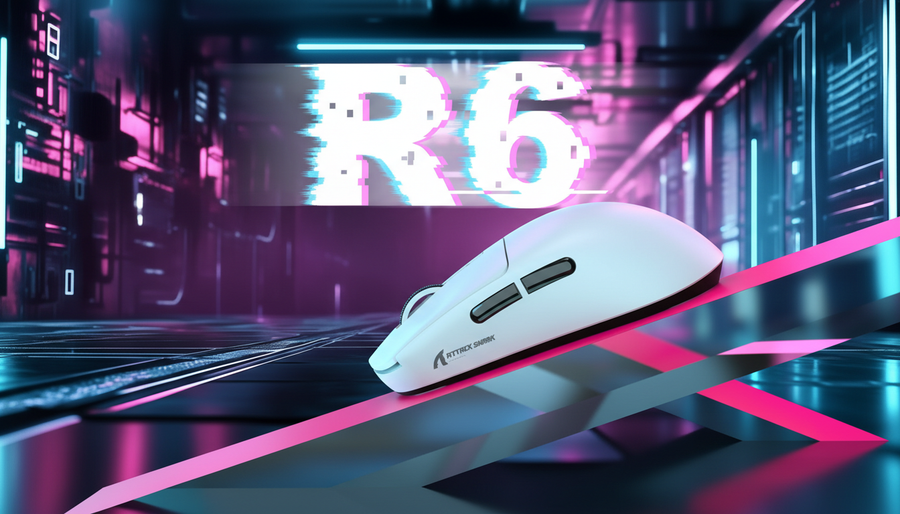
- Aplicación: Un ratón que se alinea con estas proporciones, como el ATTACK SHARK G3 Tri-mode Wireless Gaming Mouse 25000 DPI Ultra Lightweight, permite que los dedos se sitúen naturalmente cerca del CoG, minimizando el torque requerido para correcciones en el aire.
Nota: Estas son pautas heurísticas; las preferencias individuales en flexibilidad articular y volumen de la palma pueden requerir ajustes.
Requisitos de Precisión: Sinergia entre DPI y Sondeo
El equilibrio de la carcasa no existe en el vacío; debe estar respaldado por una plataforma de seguimiento estable. Para un jugador que usa un monitor 1440p y una sensibilidad de 32cm/360, el DPI mínimo matemático para evitar saltos de píxeles (basado en el Teorema de Muestreo de Nyquist-Shannon) es aproximadamente 1420 DPI.
Al usar sensores de alto rendimiento como el PixArt PAW3311 o PAW3950MAX, los jugadores suelen aumentar su DPI a 1600 o 3200 para asegurar que el sensor sature el ancho de banda de sondeo disponible. En un intervalo casi instantáneo de 0.125 ms (sondeo a 8000Hz), cualquier desequilibrio en la carcasa se magnifica. Un ligero "nose-dive" durante un levantamiento puede hacer que el sensor interprete mal la superficie al acercarse al umbral LOD, causando un "spin-out" o un fallo en el flick.
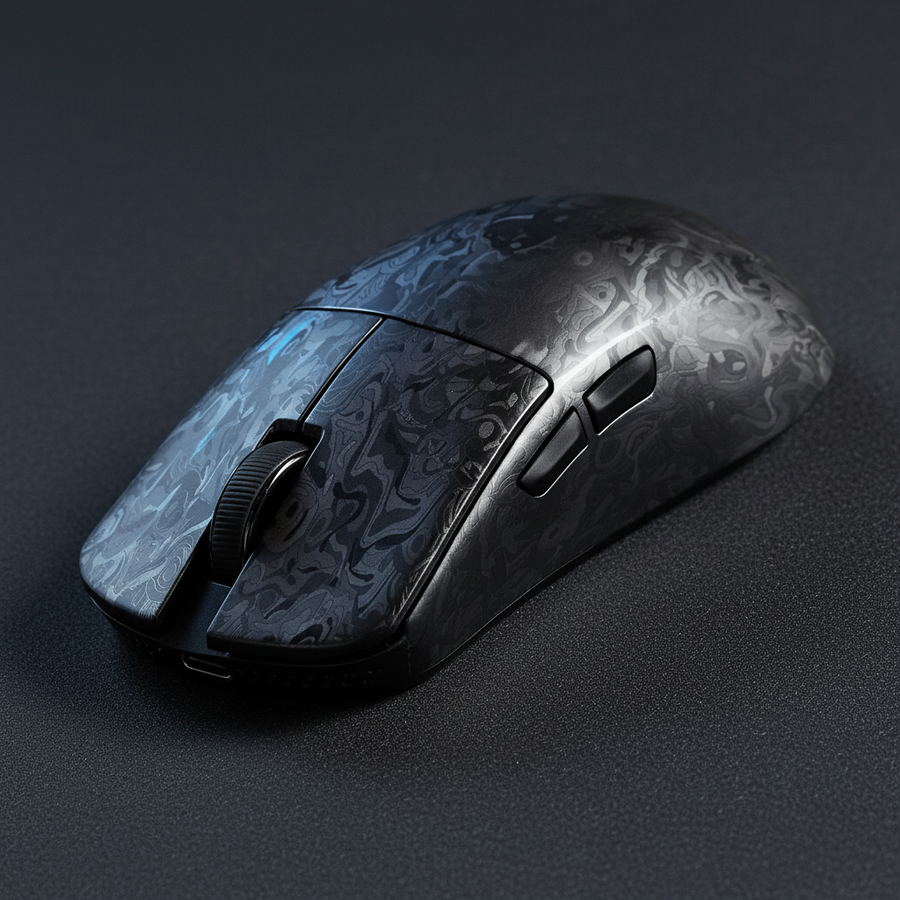
Dispositivos como el ATTACK SHARK R11 ULTRA Carbon Fiber Wireless 8K PAW3950MAX Gaming Mouse abordan esto usando fibra de carbono forjada. Este material ofrece una alta relación resistencia-peso, permitiendo a los ingenieros mantener la integridad estructural con un peso inferior a 50 g mientras posicionan con precisión los componentes internos para lograr un CoG neutral.
El Papel de la Superficie: Enmascarar vs. Amplificar el Equilibrio
La interacción entre las patas del ratón y la alfombrilla puede ocultar o resaltar defectos de equilibrio.
- Alfombrillas de Alta Fricción: Una alfombrilla con alta fricción estática, como la ATTACK SHARK CM03 eSport Gaming Mouse Pad (Rainbow Coated), puede en realidad enmascarar un equilibrio pesado hacia atrás al proporcionar más resistencia durante el movimiento inicial.
- Alfombrillas de Velocidad: Una superficie de baja fricción, como la ATTACK SHARK CM04 Genuine Carbon Fiber eSport Gaming Mousepad, amplificará cualquier problema de equilibrio. Debido a que el deslizamiento es tan fácil, la inercia rotacional causada por un CoG descentrado se convierte en la fuerza principal que siente el jugador.
Prueba de Campo: El Método de Equilibrio con los Dedos
Para los jugadores que buscan evaluar su configuración actual, recomendamos la "Prueba de Equilibrio con los Dedos", un método de campo confiable derivado de la física básica.
- Liberar el Cable: Si usas un ratón con cable, asegúrate de que el cable no esté ejerciendo tensión.
- El Pivote: Coloca tu dedo índice y medio debajo del ratón, perpendicular a su longitud.
- Encuentra el Equilibrio: Mueve tus dedos hasta que el ratón se mantenga nivelado sin inclinarse hacia adelante o hacia atrás.
- Analiza: Si este punto de pivote está a más de 10 mm de donde tus dedos descansan naturalmente durante un agarre de garra, probablemente estés luchando contra la inercia rotacional del ratón en cada reinicio en el aire.
Ingeniería para la Estabilidad Cinética
La construcción ultraligera (menos de 60 g) a menudo se promociona como el objetivo final, pero a medida que la masa disminuye, la ubicación del CoG se vuelve más perceptible, no menos. Con menos masa total para amortiguar la inercia rotacional, un ratón de 50 g con un punto de equilibrio pobre puede sentirse más "indisciplinado" que un ratón de 70 g con un equilibrio neutral.
Para el entusiasta orientado al valor, la prioridad debe ser un diseño que facilite transiciones fluidas entre estilos de agarre. Esto requiere una carcasa sólida, sin agujeros, que mantenga la rigidez bajo el contacto de alta presión de un agarre agresivo tipo garra. El ATTACK SHARK G3 Tri-mode Wireless Gaming Mouse 25000 DPI Ultra Lightweight, por ejemplo, utiliza un proceso de moldeo por inyección enfriado con nitrógeno para lograr un peso de 59g sin comprometer la integridad estructural de la carcasa.
Nota sobre el modelado: Métodos y supuestos
Las afirmaciones cuantitativas sobre esfuerzo y tensión en este artículo se derivan de modelado de escenarios basados en los siguientes parámetros. Este es un modelo determinista diseñado para ilustrar el impacto físico del desequilibrio, no un estudio clínico.
| Parámetro | Valor | Justificación / Fuente |
|---|---|---|
| Masa del ratón | 55g | Categoría competitiva ultraligera estándar |
| Longitud de la mano | 19.5cm | Percentil 75 masculino (ISO 7250-2017) |
| Desplazamiento del CoG trasero | 15mm | Desplazamiento típico en diseños ergonómicos con batería trasera |
| Contacto de los dedos | 30mm | Punto de contacto promedio del agarre tipo garra desde el frente |
| Duración de la sesión | 3 horas | Sesión estándar de práctica competitiva |
Condiciones límite: Este modelo se aplica específicamente a jugadores competitivos de FPS que usan movimientos rápidos de flick. Los resultados pueden variar para usuarios con diferentes tamaños de mano, estilos de agarre solo con la palma, o aquellos que usan ratones más pesados (>80g) donde el porcentaje de aumento de esfuerzo se amortigua por la mayor masa base.
Al comprender cómo el equilibrio de la carcasa interactúa con tu agarre y sensibilidad específicos, puedes ir más allá de la "caza del peso" y seleccionar hardware que realmente apoye tus hábitos cinéticos. Ya sea que realices un movimiento amplio de barrido o un microajuste, un CoG neutral asegura que tu enfoque permanezca en el objetivo, no en corregir el comportamiento de tu ratón.
Aviso legal: Este artículo es solo para fines informativos. Las recomendaciones ergonómicas se basan en datos y modelos de la población general; las personas con condiciones preexistentes en la muñeca o la mano deben consultar a un profesional de la salud calificado o a un especialista en ergonomía antes de realizar cambios significativos en su configuración.
Fuentes
- Libro blanco de la industria global de periféricos para juegos (2026)
- Documento de orientación de baterías de litio IATA (2025)
- ISO 9241-410:2008 - Ergonomía de la interacción humano-sistema - Criterios de diseño para dispositivos de entrada físicos
- Moore, J. S., & Garg, A. (1995). El índice de tensión
- IEEE - Shannon (1949) Comunicación en presencia de ruido