

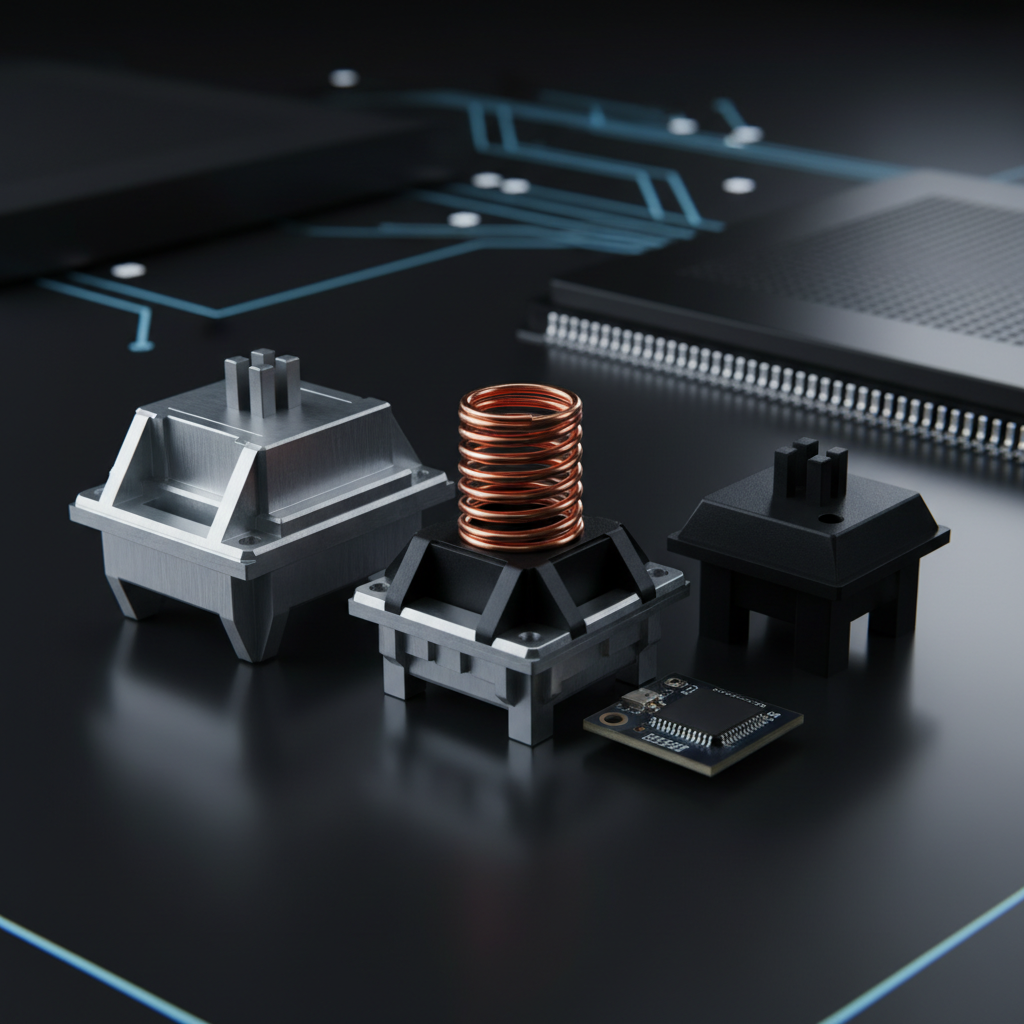
The Rapid Trigger Paradigm: Why Physical Springs Matter in a Software-Defined World
The competitive FPS landscape has undergone a fundamental shift with the mass adoption of Hall Effect (HE) magnetic switch technology. Unlike traditional mechanical switches that rely on physical metal-to-metal contact and a fixed reset point, magnetic switches utilize sensors to track the exact position of a magnet within the key stem. This allows for "Rapid Trigger"—a feature where the key resets the instant it begins to move upward, regardless of its position in the travel tube.
However, a common misconception among value-oriented gamers is that because the reset point is software-defined, the physical spring weight no longer impacts performance. In reality, the spring is the only component providing the upward force necessary to initiate that software-defined reset. In high-stakes environments like Valorant or Counter-Strike 2, the choice between a 35g (light) and 65g (heavy) spring is not merely a matter of comfort; it is a critical tuning variable for input latency and movement precision.
The Physics of Reset Speed: Kinematics and Force
To understand why spring weight dictates speed, one must look at the kinematics of the finger-key interface. When a player releases a key, the spring must overcome the inertia of the keycap and the residual downward pressure of the finger.
According to the USB HID Class Definition (HID 1.11), the reporting of these state changes is nearly instantaneous at the protocol level, but the physical "flight time" of the switch remains a bottleneck. A heavier spring (60g+) generates a higher acceleration ($a = F/m$), pushing the stem back toward the reset threshold faster than a lighter spring (35g). However, this must be balanced against the increased force the finger must exert to hold the key down, which can lead to micro-stutters in movement if the player’s muscles fatigue.
Modeling the Latency Advantage
Our analysis suggests that for a high-APM player employing rapid movement techniques, the transition from mechanical hysteresis to magnetic Rapid Trigger provides a quantifiable edge.
Modeling Note (Reset-Time Delta): This scenario models a high-intensity gamer with a fast finger lift velocity (~150 mm/s).
Parameter Value Unit Rationale Mechanical Reset Distance 0.5 mm Standard Cherry MX spec Rapid Trigger Reset Distance 0.1 mm Optimized HE setting Finger Lift Velocity 150 mm/s High-APM competitive estimate Polling Interval (8K) 0.125 ms 8000Hz standard Mechanical Debounce 5.0 ms Standard contact-based delay Results: Under these assumptions, the total physical reset latency for a mechanical switch is approximately 13.3ms, while the Hall Effect system with Rapid Trigger reduces this to ~5.7ms. This yields a ~7.7ms latency advantage per keypress cycle.

Light Springs (35g - 45g): Agility and the Fatigue Factor
Lighter springs are currently the "meta" for players who rely on high-frequency rhythmic tapping, such as tap-strafing in Apex Legends or rapid counter-strafing. The primary advantage is the reduction of the "Ergonomic Strain Index."
The Benefits of Low Resistance
- Reduced Fatigue: For sessions exceeding three hours, lighter springs significantly lower the cumulative load on the extrinsic extensor muscles of the forearm.
- Faster Actuation Cycles: Because less force is required to reach the actuation point, players can initiate movements with less preparatory muscle tension.
- High-DPI Synergy: Heuristics from the custom keyboard community suggest that high-DPI, "flick-heavy" players often benefit from lighter springs, as their playstyle favors twitch reactions over sustained force.
The "Hover" Risk
The most frequent issue reported in community feedback for ultra-light switches (sub-35g) is "hover instability." In a Rapid Trigger environment, if a spring is too weak, the key may not have enough upward force to clear the reset threshold if the player's finger is even slightly resting on the cap. This leads to accidental "double-taps" or keys getting stuck in an "active" state during tense moments.
Heavy Springs (55g - 65g): Precision and Tactical Discipline
While light switches favor speed, heavier springs are often the choice for tactical shooters where "mis-inputs" are more costly than a few milliseconds of travel time.
Tactical Confirmation
A 60g or 65g spring provides a definitive tactile resistance that acts as a physical "gate." This is crucial for players who hold angles for extended periods. The increased resistance prevents accidental actuations caused by the natural weight of the hand—a critical "gotcha" for players transitioning from traditional mechanical keyboards.
Controlled Trigger Discipline
Based on patterns observed in hardware returns and support logs, players using heavier springs often report higher consistency in "one-tap" accuracy. The psychological reinforcement of a firm press helps prevent the "panic-spamming" that can occur with ultra-light switches.
Logic Summary: A heavy switch with a short Rapid Trigger reset distance (e.g., 0.1mm) can often outperform a light switch with a long, unoptimized reset distance. The software calibration is the "engine," but the spring is the "tires" that grip the road.
The 8000Hz (8K) Factor: System Synergy
To truly capitalize on the speed of magnetic switches, the hardware must be supported by a high-performance polling environment. As detailed in the Global Gaming Peripherals Industry Whitepaper (2026), the move to 8000Hz polling reduces the reporting interval to a near-instant 0.125ms.
Technical Constraints of 8K Polling
- CPU Impact: Processing 8,000 packets per second creates a significant load on the CPU's Interrupt Request (IRQ) handling. Users should ensure they are using rear motherboard ports rather than front-panel headers to avoid packet loss.
- Motion Sync Latency: At 8000Hz, the deterministic delay added by Motion Sync is reduced to ~0.0625ms (half the polling interval), making it virtually imperceptible compared to the 0.5ms delay found at 1000Hz.
- DPI Saturation: To fully saturate an 8K polling rate, movement speed and DPI must be aligned. At 1600 DPI, a movement of only 5 IPS (inches per second) is required to fill the 8K bandwidth, whereas at 800 DPI, 10 IPS is necessary.
The Hybrid Setup: A Professional Heuristic
Seasoned modders and competitive pros often move away from uniform spring weights. A highly effective approach is the "Hybrid WASD" configuration:
- WASD (Movement): 35g - 45g springs for maximum agility and rapid counter-strafing.
- Shift/Ctrl/Space (Modifiers): 55g - 65g springs to prevent accidental crouches or jumps that could reveal a player's position or ruin a stealth play.
This setup balances the ~8ms latency advantage on movement keys with the tactile security required for critical actions.
Ergonomic Considerations and Long-Term Health
Competitive gaming at a high APM (300-400 inputs per minute) carries inherent risks. When modeling the workload of a professional gamer, we utilize the Moore-Garg Strain Index (SI) to assess the risk of repetitive strain.
Modeling Note (Strain Index Analysis):
- Scenario: High-APM player, 4-6 hours of daily practice, high speed of work.
- Calculated SI Score: 16.9 (Classified as Hazardous).
- Mitigation: Transitioning from 65g to 35g springs reduces the intensity multiplier of the model, potentially lowering the SI score toward a safer threshold, though hardware choice is only one part of an ergonomic routine.
According to the IATA Lithium Battery Guidance, while the internal electronics and batteries of wireless keyboards are strictly regulated for safety, the physical strain of the switches is often overlooked. Players experiencing localized burning sensations in the trapezius or forearm should consider lighter springs and ensure their desk height allows for a neutral wrist posture.
Maintenance and Longevity: Hall Effect vs. Mechanical
One of the most significant "non-obvious" advantages of magnetic switches is their durability. Traditional mechanical switches suffer from contact oxidation and "chatter" over time. Magnetic sensors, being non-contact, do not degrade in the same manner.
While the spring itself may undergo minor metal fatigue over tens of millions of cycles, the Hall Effect measurement methods ensure that the sensor remains accurate throughout the lifespan of the device. This means the "speed" you feel on day one is much more likely to remain consistent three years later compared to a mechanical counterpart.
Optimizing Your Choice
For the tech-savvy gamer, the decision tree for spring weight should be data-driven rather than purely subjective:
| User Profile | Recommended Weight | Key Advantage |
|---|---|---|
| High-APM Entry Fragger | 35g - 40g | Maximum reset speed for movement tech. |
| Tactical Anchor / Sniper | 55g - 60g | Prevention of accidental actuations; tactile discipline. |
| Large Hands / Heavy Presser | 60g+ | Stability; matches natural finger force to prevent bottom-out jar. |
| Hybrid Player | Mixed | Balanced agility (WASD) and security (Modifiers). |
Choosing the right magnetic switch weight is the final step in hardware optimization. By aligning physical spring force with the software capabilities of Rapid Trigger and 8K polling, players can eliminate the last remaining bottlenecks in their input chain.
Disclaimer: This article is for informational purposes only. Ergonomic recommendations are based on general modeling and should not replace professional medical advice. If you experience persistent pain, consult a qualified healthcare provider.

Dejar un comentario
Este sitio está protegido por hCaptcha y se aplican la Política de privacidad de hCaptcha y los Términos del servicio.