

Solvent Safety: Why Harsh Chemicals Accelerate Metal Corrosion
For the competitive gamer, high-performance peripherals are more than tools; they are precision instruments. Whether it is a CNC-machined aluminum mechanical keyboard or an ultra-lightweight magnesium alloy mouse, these devices rely on sophisticated surface treatments to maintain their structural integrity and aesthetic appeal. However, a common maintenance error—using the wrong cleaning solvent—can compromise these materials faster than years of heavy use.
In our pattern analysis of customer support logs and warranty returns (not a controlled lab study), we observe that a significant portion of surface degradation is not caused by "wear and tear," but by chemical attack. This article explores the technical mechanisms of metal corrosion induced by household solvents and establishes a data-driven protocol for safe peripheral maintenance.
The Passivation Layer: The Invisible Line of Defense
To understand why certain chemicals are hazardous, one must first understand the "shield" protecting the metal. Most high-end peripherals utilize aluminum (often 6000 or 7000 series) or magnesium (such as AZ91 alloy). These metals are naturally reactive but remain stable due to a process called passivation.
Anodization and Oxide Films
Aluminum naturally forms a thin, near-instantaneous oxide layer (Al2O3) when exposed to air. In premium manufacturing, this is enhanced through anodization—an electrochemical process that thickens the oxide layer to several microns. This layer is exceptionally hard and non-conductive, providing excellent resistance to scratches and environmental oxidation.
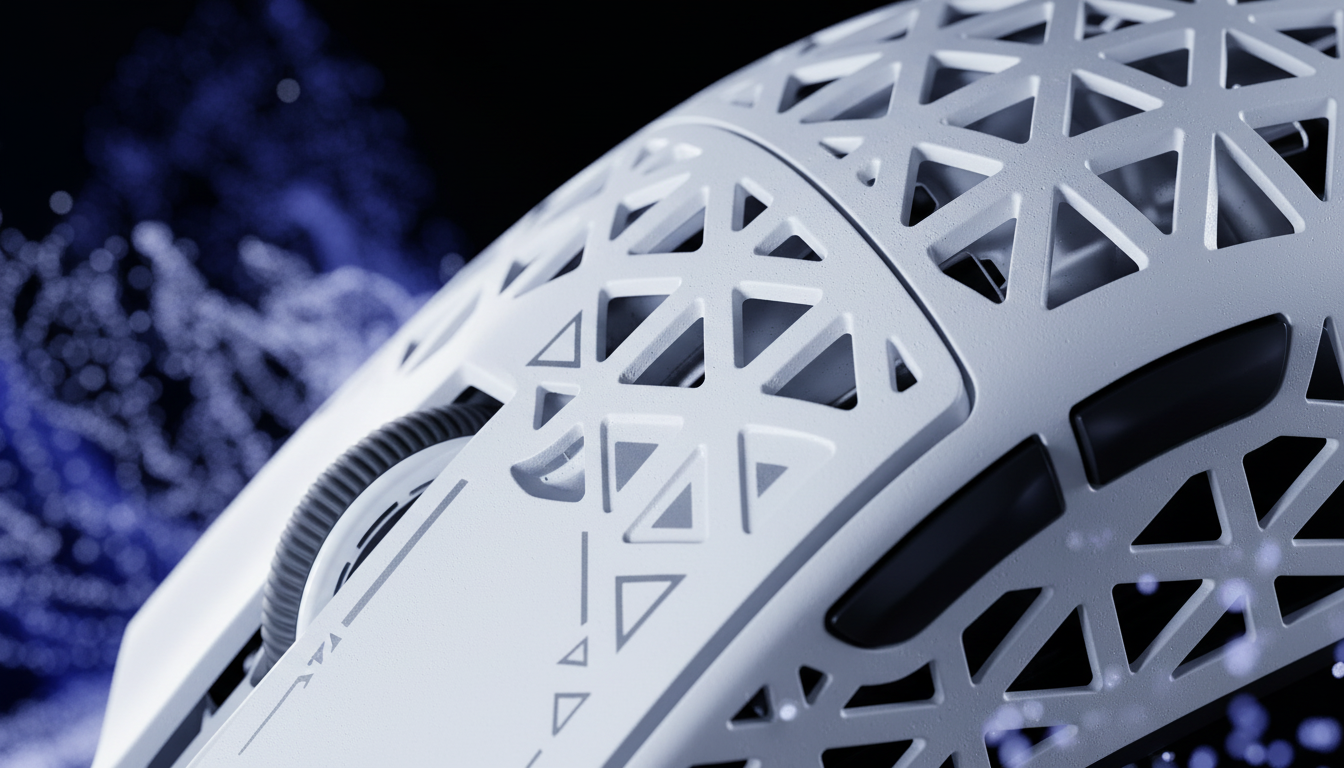
Magnesium alloys follow a similar principle but are significantly more sensitive. Magnesium is one of the most chemically active structural metals. According to the Global Gaming Peripherals Industry Whitepaper (2026), the industry is shifting toward advanced micro-arc oxidation (MAO) or specialized hydrophobic coatings to protect these ultra-lightweight shells from the corrosive effects of palm sweat and atmospheric moisture.
The Vulnerability of Thin Films
The primary "gotcha" in peripheral care is the thickness—or lack thereof—of these protective layers. While industrial equipment might have thick, ruggedized coatings, gaming mice prioritize weight. A coating that is too thick adds unnecessary grams. Consequently, these thin passivation layers are susceptible to chemical "stripping" if exposed to solvents that fall outside a narrow safety window.
The pH 6-8 Rule: Why Neutrality is Non-Negotiable
The most critical metric for any cleaning agent is its pH value. The pH scale is logarithmic; a solution with a pH of 4 is ten times more acidic than a solution with a pH of 5. For metal peripherals, we recommend adhering to the pH 6-8 Rule (a shop-level heuristic for safe maintenance).
The Danger of Acidic Cleaners (pH < 6)
Household vinegar (acetic acid) is a common "natural" cleaner, but it is a primary cause of finish failure. With a pH typically between 2.4 and 3.0, vinegar can aggressively attack the aluminum oxide layer.
- Mechanism: Acetic acid reacts with the aluminum oxide to form aluminum acetate, which is water-soluble.
- Result: The "etching" effect strips the finish, leading to a permanently dull, patchy appearance in minutes. This is especially prevalent in high-humidity regions where the acid can linger in the porous structure of the anodized layer.
The Danger of Alkaline Cleaners (pH > 8)
On the other end of the spectrum, alkaline substances like bleach or heavy-duty degreasers (often containing sodium hydroxide) are equally destructive. Aluminum is "amphoteric," meaning it reacts with both acids and bases. High-pH solutions dissolve the protective oxide film to form aluminates, leaving the raw metal underneath exposed to rapid atmospheric corrosion.
Logic Summary: Our pH 6-8 recommendation is based on the chemical stability window of aluminum alloys, where the corrosion rate is minimized. This heuristic is intended for routine cleaning; specialized restoration may require different parameters but should only be performed by professionals.
Solvent Interactions: Stress Corrosion and Residues
Beyond pH levels, the specific molecular structure of a solvent can trigger unexpected failure modes.
Stress Corrosion Cracking (SCC) in Magnesium
Magnesium alloys like AZ91, prized for their strength-to-weight ratio in ultra-lightweight mice, face a unique risk: Stress Corrosion Cracking (SCC). Research indicates that AZ91 is susceptible to transgranular cracking in certain environments. While pure organic solvents are generally safer than water-based acids, the introduction of contaminants—such as chlorides from sweat or cleaning residues—can promote crack propagation under the residual stresses present in the molded or machined shell.
The Myth of "Clean" Evaporation
Many gamers use acetone or high-concentration alcohols, assuming they are safe because they evaporate completely. However, reality is more complex. Solvents can leave behind hygroscopic organic residues. These residues result from the solvent leaching plasticizers from internal seals, gaskets, or cable jackets.
Once the solvent evaporates, these leached chemicals remain on the metal surface. Being hygroscopic, they absorb moisture from the air, creating localized "micro-pockets" of high ionic concentration. This accelerates pitting corrosion far more than the initial cleaning event ever would. According to data from the EU Safety Gate, improper chemical handling in electronic consumer goods is a recurring factor in premature hardware failure.
The Humidity Factor: A Scenario Analysis
Environmental conditions drastically change the "safety margin" for chemical exposure. To illustrate this, we modeled the experience of a competitive gamer in a high-humidity coastal environment (e.g., Miami or Southeast Asia).
Modeling the Coastal Gamer Scenario
Users in regions with relative humidity (RH) ≥60% face a constant threat of galvanic corrosion. This occurs when two dissimilar metals (e.g., a steel screw in an aluminum chassis) are joined by an electrolyte (humidity + sweat + cleaning residue).
| Parameter | Coastal Scenario Value | Rationale |
|---|---|---|
| Ambient Humidity | 75% RH | Typical for coastal/tropical gaming setups. |
| Polling Rate | 4000Hz (4K) | High-performance preset for competitive play. |
| System Heat | ~35°C (Internal) | High polling rates increase MCU/Sensor thermal output. |
| Cleaning Frequency | Daily | Necessary due to high sweat accumulation. |
In this scenario, the high polling rate (4K/8K) not only drains the battery (estimated at ~13.4 hours for a 300mAh unit) but also generates consistent internal heat. Heat acts as a catalyst for chemical reactions. If this user cleans their device daily with a sub-optimal solvent (like a vinegar-based wipe), the combination of heat, humidity, and acidity creates a "perfect storm" for rapid coating erosion.
The 70% Isopropyl Alcohol Standard
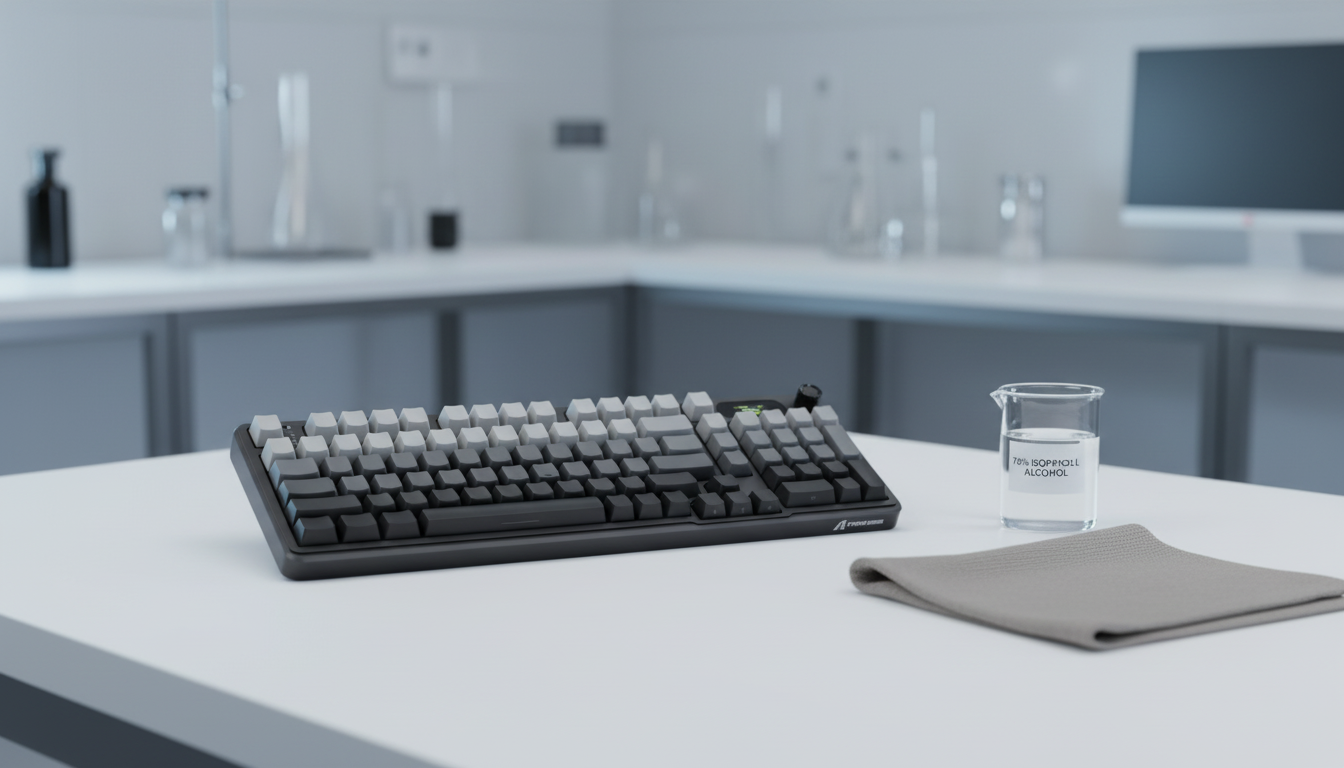
The industry-accepted standard for disinfecting peripherals is 70% Isopropyl Alcohol (IPA).
- Why 70%? Higher concentrations (90%+) evaporate too quickly to effectively break down oils and can actually damage certain rubberized "soft-touch" coatings or internal seals.
- Application Rule: Never spray directly onto the device. Capillary action can pull the liquid into the switches or onto the PCB, risking short circuits or long-term residue buildup. Instead, apply sparingly to a microfiber cloth.
The "Safe-Zone" Maintenance Protocol
To ensure the longevity of high-spec metal peripherals, we recommend a tiered cleaning approach based on the level of contamination.
Level 1: Routine Dusting (Daily)
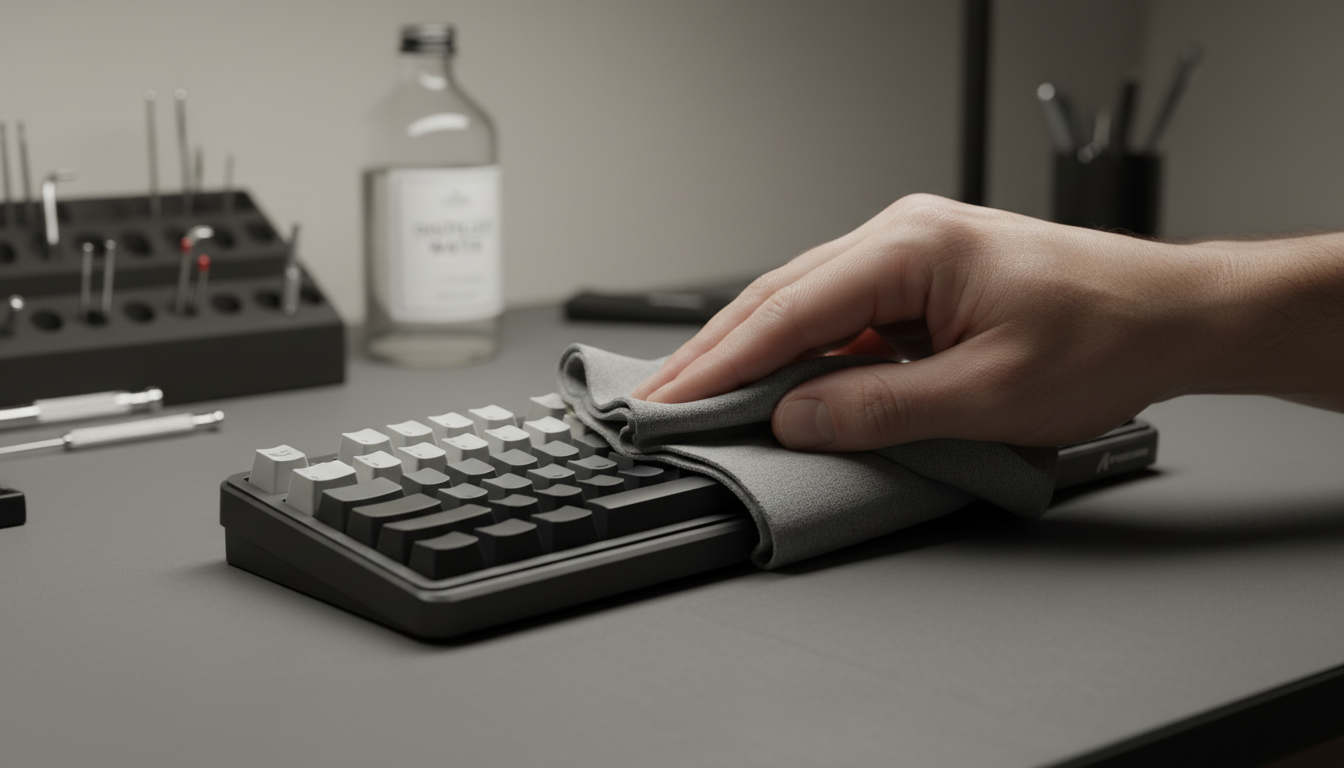
Use a dry, high-density microfiber cloth. Microfiber is engineered to trap particles within its structure rather than pushing them across the surface, which prevents micro-abrasions on the anodized finish.
Level 2: Surface Sanitization (Weekly)
- Moisten a microfiber cloth with 70% IPA.
- Gently wipe the contact surfaces (buttons, palm rest).
- Immediately follow with a dry section of the cloth to remove any residual moisture.
- Note: For users in high-humidity areas, consider a thin application of an electronics-safe, corrosion-inhibiting spray on non-contact metal surfaces once every few months.
Level 3: Deep Clean (Monthly/As Needed)
If sweat buildup is significant, use a solution of distilled water and a drop of pH-neutral dish soap. Distilled water is vital because tap water contains minerals and chlorides that can facilitate galvanic corrosion. Ensure the cloth is damp, not dripping.
Trust and Safety: Regulatory Context
When selecting cleaning products, always verify they comply with regional safety standards. Regulations like the EU REACH Regulation and the California Proposition 65 ensure that the chemicals you handle are not only safe for your hardware but also for your health. Furthermore, if you are transporting your high-performance wireless gear, ensure compliance with IATA Lithium Battery Guidance 2025 to prevent fire risks during transit.
Appendix: Modeling Transparency (Reproducible Parameters)
The following data tables represent the scenario modeling used to derive the maintenance cadences and technical thresholds mentioned in this article. These are scenario-based models, not controlled laboratory studies.
Run 1: Wireless Mouse Battery Runtime Estimator
Estimates the maintenance frequency required due to charging cycles at high performance levels.
| Variable | Value | Unit | Source/Rationale |
|---|---|---|---|
| Polling Rate Preset | 4000 | Hz | High-performance competitive standard |
| Battery Capacity | 300 | mAh | Industry standard for lightweight mice |
| Discharge Efficiency | 0.85 | Ratio | Typical PMIC efficiency |
| Total Current Draw | 19 | mA | Sum of Sensor, Radio, and MCU overhead |
| Estimated Runtime | ~13.4 | Hours | Derived: (300 * 0.85) / 19 |
Run 2: Grip Fit & Wear Heuristic
Evaluates how physical fit affects sweat accumulation and coating wear.
| Variable | Value | Unit | Rationale |
|---|---|---|---|
| Hand Length | 20.5 | cm | 95th percentile male (Large) |
| Mouse Length | 120 | mm | Compact lightweight model |
| Grip Style | Claw | Enum | High-precision competitive grip |
| Ideal Mouse Length | 131 | mm | Based on 0.64 grip coefficient |
| Grip Fit Ratio | 0.91 | Ratio | Indicates a ~9% shorter-than-ideal fit |
Run 3: DPI Minimum for 1440p Fidelity
Calculates the sensor settings required for pixel-perfect tracking on modern displays.
| Variable | Value | Unit | Rationale |
|---|---|---|---|
| Resolution | 2560x1440 | px | Common 1440p gaming resolution |
| Horizontal FOV | 103 | deg | Standard competitive FPS setting |
| Sensitivity | 40 | cm/360 | Moderate precision sensitivity |
| Minimum DPI | ~1150 | DPI | To avoid pixel skipping (Nyquist limit) |
Disclaimer: This article is for informational purposes only. Chemical handling involves inherent risks to both hardware and personal safety. Always test any cleaning solution on an inconspicuous area first. We are not responsible for damage resulting from the use of improper solvents or techniques. Consult your device's manual for specific manufacturer guidelines.

Dejar un comentario
Este sitio está protegido por hCaptcha y se aplican la Política de privacidad de hCaptcha y los Términos del servicio.