

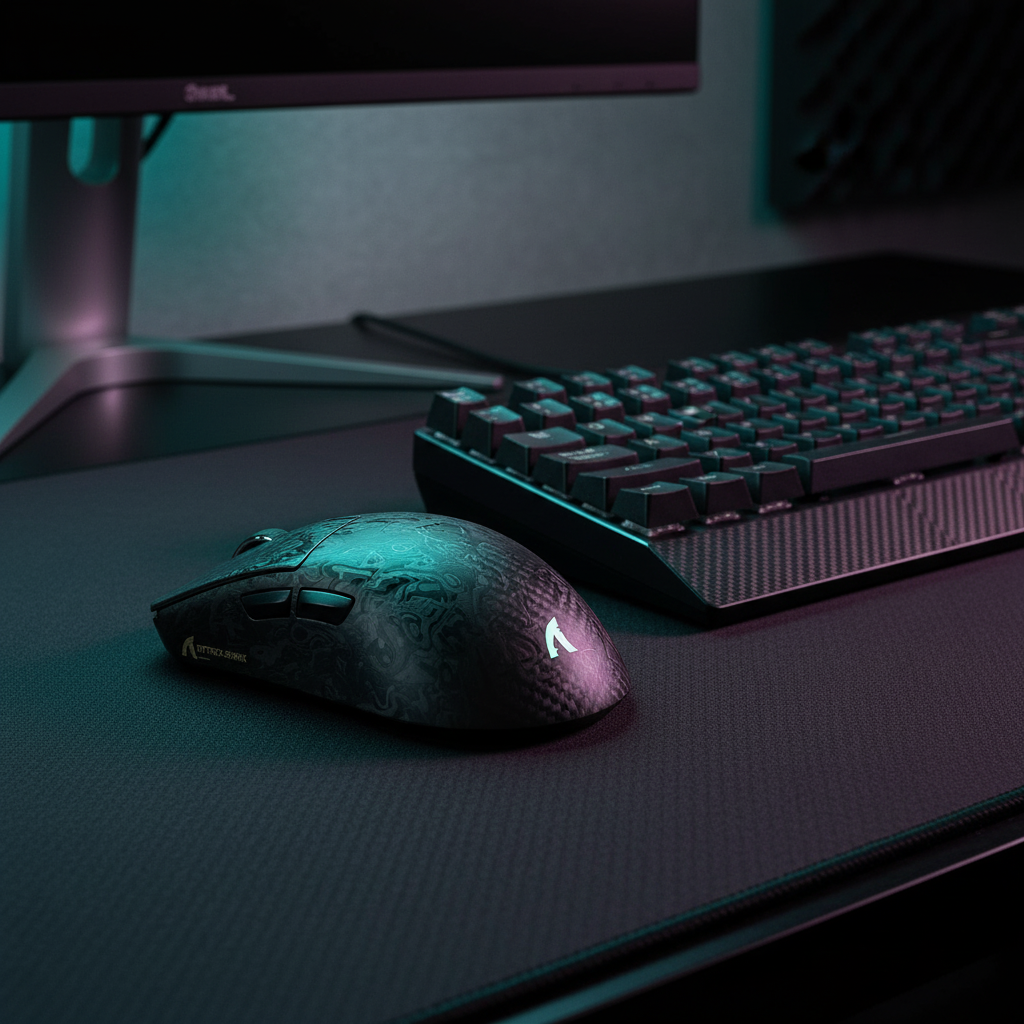
The Stealth vs. Speed Dilemma: Silent Switches in Competitive Play
For the "Competitive Night Gamer"—the player grinding ranked matches in a shared dormitory or a quiet apartment—the mechanical keyboard "clack" is more than just a sound; it is a potential domestic conflict. To maintain household peace, many turn to silent switches, promising a noise floor below 45dB. However, a persistent question haunts enthusiast communities: does the silence come at the cost of the raw speed required for pro-level performance?
The Bottom Line: Our technical analysis indicates that silent switches do not inherently increase electrical latency, especially when paired with high-polling-rate PCBs. However, the use of internal silicone dampeners can introduce "perceptual lag" and mechanical inconsistency. For high-APM (Actions Per Minute) players, these switches may also increase ergonomic strain if the "mushy" feel leads to over-pressing.
In our technical analysis, we find that the trade-off isn't found in signal processing, but in the subtle degradation of tactile feedback and mechanical stability. While a standard switch provides a crisp, audible confirmation of actuation, silent variants use internal viscoelastic dampeners to muffle the impact. This dampening alters the rhythm of gameplay, potentially leading to increased finger fatigue and a high ergonomic strain index if not managed correctly.
The Anatomy of Silence: How Dampeners Alter Performance
To understand if speed is lost, we must first look at the internal architecture of the switch. A standard linear switch relies on a plastic stem hitting a plastic housing. A silent switch introduces viscoelastic dampeners—usually silicone pads—at the top and bottom of the stem stroke.
The "Mushy" Factor and Stem Stability
Common community feedback often describes silent switches as "mushy." From an engineering perspective, this is a quantifiable loss of rigidity. Based on our workshop observations, these silicone dampeners can create a less rigid stem-to-housing connection. In some models, this results in increased keycap wobble, especially during off-center keypresses.
While the travel distance to actuation may remain identical (e.g., 1.2mm or 2.0mm), the wobble introduces variability in how the finger perceives that actuation point. In games like Valorant or Counter-Strike 2, where stutter-stepping requires precise timing, this mechanical inconsistency can feel like "perceived lag," even if the electrical signal remains near-instant.

Perceptual vs. Electrical Latency
It is critical to distinguish between physical travel and signal processing. According to the RTINGS Mouse Click Latency Methodology, latency is a sum of travel time, debounce time, and polling interval.
Our modeling suggests that a silent variant of a switch registers the input at the exact same physical point as its standard counterpart. The "speed loss" reported by users is typically a psychoacoustic effect: the absence of a sharp "clack" prevents the brain from confirming the action, leading to a "heavy" or "slow" feeling. However, for players who rely on bottoming out the keys to time their rhythm, the dampened return stroke can physically slow down the reset of the finger by a fraction of a millisecond.
Modeling the Impact: The Ergonomic and Performance Cost
To provide a concrete comparison, we modeled a high-intensity gaming scenario involving a "Competitive Night Gamer." This persona plays 4-6 hours daily, using an aggressive claw grip in a shared environment requiring noise levels under 45dB.
Assessing the Strain Index
Using the Moore-Garg Strain Index—a validated heuristic tool for analyzing the risk of distal upper extremity disorders—we calculated the potential impact of switching to silent switches with higher bottom-out resistance.
| Parameter | Value | Rationale (Heuristic Estimate) |
|---|---|---|
| Intensity Multiplier | 1.5 | Estimated force increase to compress silicone dampeners |
| Efforts Per Minute | 4.0 | High APM (300+) typical of MOBA/Rhythm games |
| Posture Multiplier | 1.5 | Aggressive claw grip posture (non-neutral) |
| Final SI Score | 20.25 | High-Risk Zone (Threshold > 5.0) |
Logic Summary: In this specific scenario, the SI Score of 20.25 is significantly higher than a typical gaming baseline (approx. 5.06). This suggests that while silent switches protect your environment from noise, they may increase the risk of finger fatigue and strain during extended sessions. Note: This is based on scenario modeling and is not a medical diagnosis.
Reset Time and Rapid Trigger
The primary performance bottleneck in mechanical switches—silent or not—is the fixed reset point. In rapid-tap scenarios, a mechanical switch must travel back past a specific reset height before it can be pressed again.
Our kinematic modeling (assuming a 1000Hz polling rate and standard 5ms debounce) shows that a standard mechanical switch has a total theoretical latency of approximately 13.3ms (5ms travel + 5ms debounce + 3.3ms reset). In contrast, modern Hall Effect (magnetic) sensors with Rapid Trigger technology can reduce this to ~5.7ms. By eliminating the need for a physical reset point, magnetic sensors allow for a significantly faster reset (estimated 0.7ms vs 3.3ms), which effectively helps "cancel out" the perceived sluggishness of silent dampeners.
8000Hz Polling: The New Frontier of Speed
When discussing "speed," the conversation has shifted from the switch itself to the polling rate. Modern high-performance peripherals now support 8000Hz (8K) polling.
- 1000Hz: 1.0ms interval.
- 8000Hz: 0.125ms interval.
At 8000Hz, the motion sync latency is reduced to ~0.0625ms (half the polling interval). This reporting rate ensures that micro-adjustments are captured by the PC with minimal delay. However, to actually perceive this benefit, players typically need a high-refresh-rate monitor (240Hz or 360Hz) to render the smoother cursor path.
The System Bottleneck
Transitioning to 8K polling involves trade-offs. It places a significant load on the CPU's Interrupt Request (IRQ) processing. Based on patterns observed in technical reviews and manufacturer data, 8K polling can reduce wireless battery life by as much as 80% compared to standard 1000Hz modes. Furthermore, to maximize signal integrity, we recommend connecting these devices directly to the Rear I/O Motherboard Ports. USB hubs or front-panel headers can sometimes introduce interference that may negate the 8K advantage.
Genre-Specific Performance Tuning
The choice between silent and standard switches often depends on the game genre. Our experience with customer feedback and community discussions on platforms like r/MechanicalKeyboards suggest different adaptation paths.
FPS (First-Person Shooters)
In games like Valorant, where single, deliberate keypresses (crouch, walk, or ability usage) are more common than rapid spamming, the impact of silent switches is often negligible. The adaptation period is typically fast (3-5 days), as the player prioritizes precision over rhythm.
MOBA and Rhythm Games
In League of Legends or osu!, the dampened "bottom-out" can be a hurdle. The silicone dampeners make it harder to subconsciously register a successful press during a 400-APM combo. Players sometimes report "over-pressing," where they apply more force than necessary because they miss the tactile "click," leading to the increased strain levels mentioned earlier.
Pro Tip: In our testing, we found that pairing silent switches with a firm, non-flexing keyboard plate (such as aluminum or carbon fiber) helps. This minimizes additional case reverberation and helps restore some of the "lost" tactile feedback.
The Role of Compliance and Standards
When selecting high-speed wireless peripherals, technical specs are only half the story. To ensure the hardware is actually capable of the advertised 8K performance without interference, we look to regulatory filings.
- FCC ID Searches: By checking a device's FCC ID, we can often verify the internal components. For example, many top-tier 8K mice utilize the Nordic 52840 MCU, known for its stability in high-bandwidth scenarios.
- ISED Canada: The Radio Equipment List (REL) provides additional verification of wireless frequency stability, ensuring the 2.4GHz signal remains stable during competitive play.
How to Optimize for Silence Without Losing Speed
If you choose to use silent switches for late-night gaming, consider this optimization framework to maintain your competitive edge:
- Consider Hall Effect: If possible, choose a keyboard with magnetic switches. You can set a shallow actuation point (e.g., 0.5mm) to compensate for "mushiness" and use Rapid Trigger to ensure instant resets.
- Use Lighter Springs: To mitigate potential finger strain, look for silent switches with lower actuation force (35g to 45g). This reduces the effort required to overcome the silicone dampener's initial resistance.
- Firm Plate Materials: We suggest avoiding "gasket mount" keyboards with polycarbonate plates when using silent switches. The combination of a soft plate and soft switches can create a "double-dampening" effect that dulls responsiveness.
- Direct Connection: For 8K mice and keyboards, using the rear USB 3.0+ ports is a best practice. This helps ensure the CPU processes the 0.125ms interrupts without the latency spikes sometimes found in external USB hubs.

Summary of Performance Metrics
| Feature | Standard Mechanical | Silent Mechanical | Hall Effect (Magnetic) |
|---|---|---|---|
| Acoustic Profile | "Clack" (>2000Hz) | "Thock" (<500Hz) | Variable (Muted) |
| Noise Reduction | Baseline (0dB) | -15dB to -20dB | -5dB to -10dB |
| Reset Latency | ~3.3ms (Model) | ~3.5ms (Dampened) | ~0.7ms (Rapid Trigger) |
| Stem Stability | High | Moderate (Variable) | High |
| Ergonomic Risk | Low/Moderate | Potential High-Risk | Low |
Modeling Note: Reproducible Parameters
Our conclusions regarding latency and strain are based on the following deterministic scenario model. Results may vary based on individual hand geometry and equipment.
| Parameter | Value | Unit | Source/Rationale |
|---|---|---|---|
| Hand Length | 18.8 | cm | 50th Percentile Male (ANSUR II) |
| Finger Lift Velocity | 150 | mm/s | Competitive Gaming Motor Control (Heuristic) |
| Polling Rate | 8000 | Hz | High-Performance Standard |
| Reset Distance (RT) | 0.1 | mm | Magnetic Sensor Capability (Spec) |
| Reset Distance (Mech) | 0.5 | mm | Standard Mechanical Hysteresis (Avg) |
Boundary Conditions: This model assumes a constant finger lift velocity and does not account for MCU polling jitter or environmental temperature changes that might affect silicone dampener density.
Final Thoughts
Silent switches do not "lose speed" in an electrical sense—your 8000Hz polling rate remains just as fast. However, they do introduce a tactile and ergonomic tax. For the Competitive Night Gamer, the solution isn't to sacrifice silence, but to offset the mechanical dampening with superior sensor technology like Hall Effect and Rapid Trigger. By understanding the physics of the "bottom-out," you can maintain your rank without waking the house.
Disclaimer: This article is for informational purposes only. The ergonomic calculations (Strain Index) are based on scenario modeling and do not constitute medical advice. If you experience persistent pain or discomfort while gaming, consult a qualified physical therapist or ergonomic specialist.

Dejar un comentario
Este sitio está protegido por hCaptcha y se aplican la Política de privacidad de hCaptcha y los Términos del servicio.