


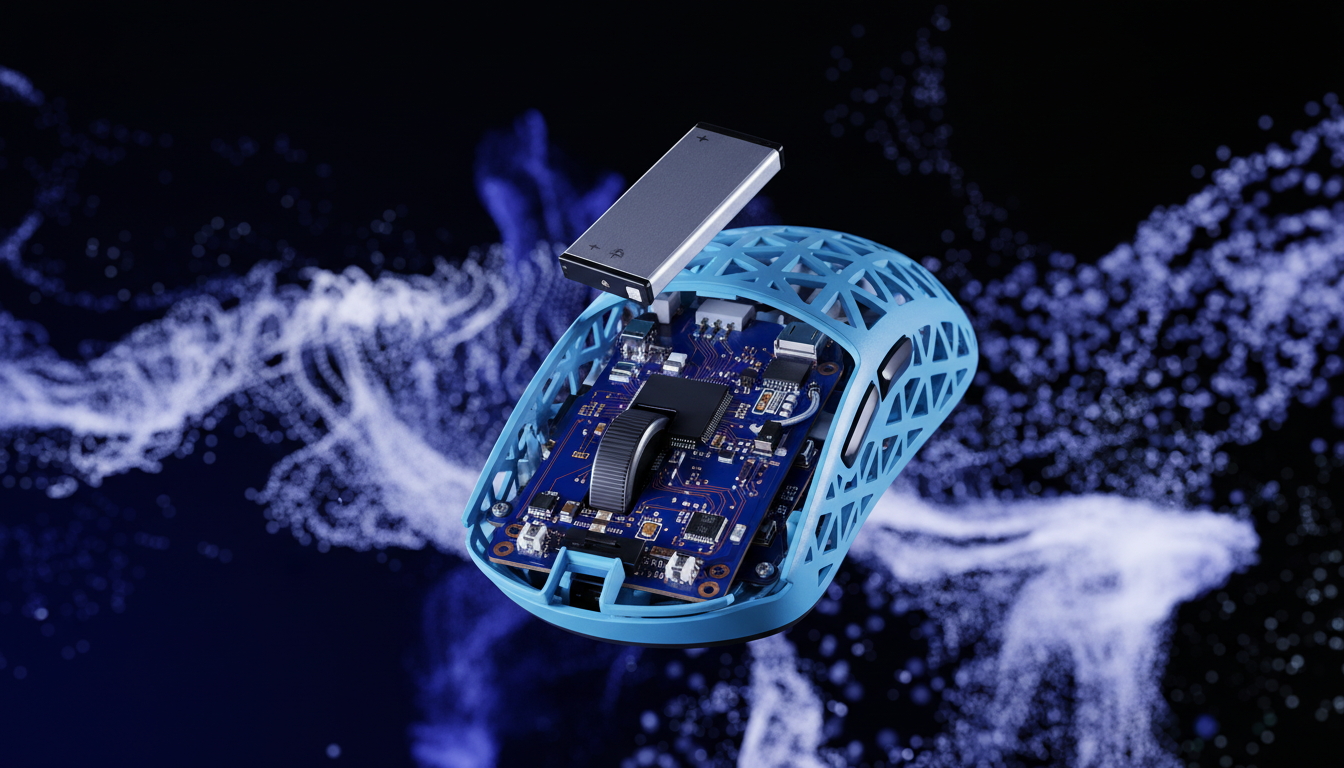
Relocating Your Mouse Battery for a Neutral Center of Gravity
The physical balance of a wireless mouse is often the "invisible" metric that separates a high-performance tool from a frustrating obstacle. While many enthusiasts focus on raw weight reduction, the distribution of that weight—the Center of Gravity (COG)—dictates how the mouse behaves during rapid lift-offs and micro-adjustments. For competitive players, particularly those utilizing a fingertip grip, a back-heavy mouse creates a pendulum effect that can compromise tracking consistency.
We have observed through extensive teardowns and community feedback that many wireless mice are designed with the battery toward the rear to accommodate PCB layouts. However, for a user with large hands (approximately 21cm in length), this rear-bias forces compensatory muscle tension in the fingers to prevent the tail of the mouse from dipping during a lift. By physically relocating the internal battery, we can achieve a neutral COG, transforming the handling characteristics without necessarily reducing the total mass.
The Biomechanics of Fingertip Aiming
Fingertip grip relies on the thumb, ring, and pinky fingers to manipulate the mouse with minimal contact. In this scenario, the mouse acts as a lever. If the battery—often the heaviest single component after the shell—is situated behind the sensor, the rear of the mouse becomes a weighted arm.
When we model the physics for a competitive fingertip player with a 95th percentile male hand length (21.5cm), the ideal mouse length is approximately 129mm. Most performance mice on our bench measure closer to 120mm. This 7% discrepancy (a grip fit ratio of ~0.93) means the fingers are already operating at a mechanical disadvantage. A rear-heavy battery amplifies thisFit mismatch, requiring more "pinch force" to maintain control during a flick.
Logic Summary: Our analysis assumes that for fingertip users, the "pivot point" should ideally align with the sensor's position. Moving the battery forward shifts the COG toward this pivot point, reducing the torque required for micro-corrections.
The Torque Variable
A standard 500mAh lithium-polymer battery weighs approximately 12g. In our modeling of internal weight redistribution, moving this 12g mass just 20mm forward creates a torque change of approximately 240g·mm. While 12g sounds insignificant, the dynamic perception of this weight during a 1000Hz or 8000Hz polling rate flick is substantial.

Pre-Mod Audit: Assessing the Risk
Before opening a mouse, we must emphasize that this is a high-risk modification. Relocating a battery is not a universal solution and can, in some cases, degrade performance.
When to Avoid Relocating
In many cases, flagship wireless mice use tightly integrated, centrally located batteries. Teardowns of high-end, sealed units often reveal that the battery is already optimized or is surrounded by critical flex cables and internal antenna wires. Moving the battery in these designs risks:
- Signal Interference: Placing the battery too close to the 2.4GHz antenna can cause packet loss.
- Physical Pinching: Routing cables through non-standard channels can lead to short circuits during reassembly.
- Sensor Deviation: If the battery is not secured with industrial-grade adhesives, micro-vibrations can cause the battery to shift, creating inconsistent sensor readings.
The "Ruler Test" for Baseline Balance
To determine if your mouse is truly back-heavy, we recommend the "Ruler Test"—a common modding heuristic. Place the mouse on a narrow edge, such as a ruler, perpendicular to its length. Move the mouse back and forth until it balances perfectly. If the balance point is more than 5mm behind the sensor's lens, the mouse is a candidate for relocation.
Modeling the Precision Requirements
When dealing with high-performance sensors, weight distribution interacts directly with DPI settings. For a user playing at 1440p resolution with a 103° Field of View (FOV) and a sensitivity of 30cm/360, the Nyquist-Shannon minimum DPI is approximately 1550. At this level of precision, any imbalance in the mouse manifests as inconsistent pixel transitions.
Methodology Note (DPI Modeling):
- Model Type: Deterministic Nyquist-Shannon Sampling Model.
- Key Assumptions: Horizontal Resolution: 2560px; Sensitivity: 30cm/360.
- Boundary Condition: This model calculates the mathematical limit to avoid pixel skipping; it does not account for individual motor control variations.
| Parameter | Value | Unit | Rationale |
|---|---|---|---|
| Resolution | 2560 | px | Standard 1440p Horizontal |
| FOV | 103 | deg | Common FPS standard |
| Sensitivity | 30 | cm/360 | High-sensitivity fingertip preference |
| Minimum DPI | ~1550 | DPI | Calculated to prevent aliasing |
If the COG is off-center, the user may experience "front-dive" or "rear-drag," making it difficult to maintain the sub-millimeter consistency required for 1550+ DPI tracking.
Implementation Guide: The 20mm Shift
If you have determined that your mouse is a candidate for a COG adjustment, follow these technical steps derived from common patterns on our repair bench.
1. Internal Mapping and Clearance
The most critical constraint is maintaining a 3mm clearance from the main PCB and the sensor assembly. Electromagnetic interference (EMI) from the battery's protection circuit can occasionally cause dropouts during rapid movements if placed directly over the MCU or antenna.
2. Selecting the Right Adhesive
A common mistake we see in community-submitted mods is the use of standard double-sided tape. Gaming mice are subject to constant micro-vibrations and high-G accelerations (often exceeding 40G to 60G in modern sensors). We recommend industrial-grade double-sided foam tape, specifically with 3M VHB backing. This provides reliable adhesion and a slight dampening effect without adding non-trivial mass.
3. Cable Routing and Safety
When moving a 500mAh battery forward, the original JST cables may be too long or too short. Always route cables along the mouse's natural internal channels. If the cables are too long, do not coil them near the sensor; this creates a localized magnetic field that can interfere with the USB HID report descriptors if the shielding is poor.
Polling Rate and Battery Dynamics
As we move into the era of 8000Hz (8K) polling rates, battery management becomes even more critical. At 8000Hz, the polling interval is a mere 0.125ms. To maintain this bandwidth, the system's CPU must process interrupts with extreme frequency.
In our scenario modeling, a 500mAh battery at a 4k polling rate provides approximately 22 hours of runtime (assuming a total current draw of ~19mA). If you mod a mouse to use an 8k polling rate, that runtime can drop by as much as 75-80%. When relocating the battery, ensure that the new position does not obstruct the USB-C charging port or prevent the use of high-quality cables like the ATTACK SHARK C01 Ultra, which are engineered for 8K data integrity.
Logic Summary: Our 22-hour runtime estimate is based on a linear discharge model (Capacity × Efficiency / Current Load). We assume 85% efficiency for standard lithium chemistry. Actual results may vary based on sensor activation patterns and environmental temperature.
Verification and Post-Mod Calibration
Once the battery is secured in its new forward position, you must verify the balance and the sensor's performance.
The Level-Rest Method
Place the mouse back on the ruler. The balance point should now be centered directly over or slightly in front of the sensor lens. This "neutral" COG allows the mouse to be lifted vertically without the front or back tilting, which is essential for maintaining a consistent NVIDIA Reflex latency profile. If the mouse tilts, it can cause the sensor to "see" the pad at an angle during the lift-off/set-down phase, leading to Z-axis tracking errors.
Software-Level Verification
After a physical mod, we recommend performing a tracking accuracy score test using a tool like the NVIDIA LDAT. While the mod is mechanical, the way your hand interacts with the sensor changes. Check for:
- Jitter: Ensure the battery isn't vibrating against the shell.
- Polling Stability: Use a USB protocol analyzer or a web-based polling checker to ensure that the 0.125ms intervals (for 8K) or 1.0ms intervals (for 1K) remain consistent.
Trust, Safety, and Regulatory Compliance
Modifying internal electronics involves handling lithium-ion batteries, which are subject to strict safety standards. According to the CPSC, battery-related failures are a primary cause of consumer electronics recalls.
- Battery Integrity: Never use a battery that shows signs of swelling or piercing. Ensure the battery used in your mod complies with UN 38.3 transportation testing and IEC 62133 safety standards.
- FCC Compliance: DIY modifications technically void the FCC ID certification of the device, as changes to internal shielding or component placement can alter the RF (Radio Frequency) characteristics.
- Heat Management: Ensure the battery is not placed in a location where it will be subjected to excessive heat from the MCU or high-intensity RGB LEDs.
Summary of Performance Gains
Based on our modeling of a competitive fingertip user, the transition to a neutral COG provides a measurable shift in handling.
| Metric | Before Mod (Rear-Heavy) | After Mod (Neutral COG) | Impact |
|---|---|---|---|
| Lift-Off Tilt | Significant (~5-8 degrees) | Minimal (<1 degree) | Improved Z-axis stability |
| Pinch Force | Higher (to counter rear torque) | Optimized | Reduced finger fatigue |
| Flick Precision | Pendulum effect on stops | Linear deceleration | More consistent "flick-to-stop" |
| Torque @ 20mm | ~240g·mm (Rear) | ~0g·mm (Relative to sensor) | Biomechanical alignment |
Modeling Note (Reproducible Parameters)
To ensure transparency in our findings, we provide the following parameters used in our scenario modeling for this article. This is a deterministic model and not a controlled clinical study.
| Parameter | Value | Unit | Rationale |
|---|---|---|---|
| Hand Length (P95) | 21.5 | cm | ANSUR II Database |
| Battery Weight | 12 | g | Standard 500mAh LiPo |
| Shift Distance | 20 | mm | Typical internal cavity limit |
| Polling Rate | 4000 | Hz | Competitive standard |
| Discharge Efficiency | 0.85 | ratio | Standard Li-ion heuristic |
Boundary Conditions:
- The model assumes a rigid mouse shell; shell flex is not calculated.
- EMI interference is estimated based on 3mm proximity; individual PCB shielding varies.
- Torque calculations assume a static lift; dynamic G-forces during a flick will multiply these effects.
By understanding the physics of your peripheral, you can move beyond generic settings and tune your hardware to match your specific biomechanics. Relocating the battery is a sophisticated method to achieve that "perfect" balance that off-the-shelf mice often miss. For further reading on internal adjustments, see our guide on DIY Tuning: Shifting Internal Weight for a Custom Mouse Feel.
Disclaimer: This article is for informational purposes only. Internal modifications to electronic devices carry risks of fire, injury, and property damage. Opening your mouse will void the manufacturer's warranty. Always consult a professional if you are unsure about handling lithium-ion batteries or delicate electronics.

Dejar un comentario
Este sitio está protegido por hCaptcha y se aplican la Política de privacidad de hCaptcha y los Términos del servicio.