


Quick Summary: Kinetic Stability vs. Ultra-Lightweight
For gamers deciding between magnesium and ultra-light alternatives (like carbon fiber), here are the engineering-driven takeaways:
- The "Stop" Advantage: Magnesium’s density increases Moment of Inertia (MOI), providing a natural physical "brake" that reduces overshooting in flick shots.
- Optimal Setting: To maximize 8000Hz polling, a minimum of 1600 DPI is recommended to ensure the sensor saturates the data stream during micro-adjustments.
- Surface Pairing: Denser magnesium shells pair best with glass pads to balance high kinetic stability with low static friction.
- Quick Checklist: Jump to the Implementation Guide
Kinetic Stability: Why Magnesium Density Improves Flick Stops
In the competitive landscape of tactical shooters like VALORANT and CS2, the industry has been dominated by a singular narrative: lighter is always better. While reducing mass decreases the initial force required to move a mouse, it also reduces the force required to stop it. For many high-level players, an ultra-light mouse (sub-50g) can lead to "overshoot"—a phenomenon where the device continues to move past the intended target because the user's wrist cannot provide enough counter-braking force in time.
This article analyzes the engineering shift toward magnesium alloy shells. While magnesium is often marketed for its weight-saving properties compared to zinc or steel, its true advantage in a competitive context lies in its density-to-volume ratio. By strategically utilizing a slightly denser material than traditional ABS plastic, engineers can tune the device's rotational inertia to improve flick consistency.

The Physics of Stopping Power: Rotational Inertia and MOI
To understand why a magnesium shell feels more "planted" during a flick, one must look beyond total mass and examine the Moment of Inertia (MOI). In physics, MOI measures an object's resistance to rotational acceleration about an axis—usually the user's wrist or elbow pivot.
The MOI Calculation: Why 5g Matters
The resistance to stopping a mouse is governed by the simplified formula: $$I = \sum m_i r_i^2$$ Where $I$ is the Moment of Inertia, $m$ is the mass, and $r$ is the distance from the pivot point.
Quantitative Example (Model-Based): Consider a mouse where a design change shifts 5g of mass from the center of the mouse to the outer magnesium shell (approximately 5cm from the wrist pivot).
- Change in MOI: $5\text{g} \times (5\text{cm})^2 = 125\text{ g}\cdot\text{cm}^2$.
- Impact: Even if the total weight remains low, this peripheral mass distribution increases the torque required to "stop" the rotation by an estimated 10–15% compared to a hollow plastic shell. This acts as a natural mechanical dampener.
Kinetic Stability as a Metric
According to the Attack Shark Manufacturer Whitepaper (2026), "Kinetic Stability" is used as an internal engineering framework to describe how a material's density distribution affects the settling time of a crosshair. While not an ISO standard, this heuristic aligns with observations in competitive play where a slightly higher MOI provides a more predictable "braking" sensation, reducing the need for active muscular micro-adjustments.
Material Engineering: Magnesium Alloys in Peripheral Design
The choice of alloy determines the shell's durability and tactile feedback. Most gaming mice utilize die-cast alloys to achieve thin-wall structures that plastic cannot replicate without flexing.
AZ91D vs. AM60B
Technical data from the North American Die Casting Association (NADCA) suggests that while AZ91D is the "standard," AM60B offers specific advantages for high-impact peripherals.
| Property | AZ91D Alloy | AM60B Alloy | Engineering Rationale |
|---|---|---|---|
| Tensile Strength | ~230 MPa | ~220 MPa | Structural rigidity |
| Elongation (Ductility) | ~3% | ~6–8% | Impact absorption (Desk slams) |
| Density | 1.81 g/cm³ | 1.80 g/cm³ | Weight-to-volume ratio |
| Vibration Damping | Moderate | High | Perceived "solid" feel |
Observation: AM60B’s higher elongation allows the mouse to absorb kinetic energy more effectively. This contributes to the "deadening" of vibration when the mouse is brought to a hard stop, a quality often described by enthusiasts as a "premium, planted feel."

Scenario Modeling: 8000Hz and Motion Sync Logic
To quantify the benefits of high-performance electronics, we modeled a scenario involving a competitive player using an 8000Hz (8K) polling rate.
Motion Sync and Latency Trade-offs
"Motion Sync" aligns sensor data reports with the USB polling interval. While this improves path smoothness, it introduces a deterministic latency penalty.
| Polling Rate | Interval | Motion Sync Penalty (Est.) |
|---|---|---|
| 1000Hz | 1.0ms | ~0.5ms |
| 4000Hz | 0.25ms | ~0.125ms |
| 8000Hz | 0.125ms | ~0.062ms |
Threshold Heuristic: To maintain a saturated 8000Hz stream (preventing "empty" polls), the user must generate enough counts per second.
- At 800 DPI: Requires a movement speed of ~10 IPS (Inches Per Second).
- At 1600 DPI: Requires only ~5 IPS.
- Note: These are theoretical minimums based on USB HID Class Definitions.
Modeling Assumptions (Performance Table)
The values below are derived from a deterministic parameterized model for a tournament-grade setup.
| Parameter | Value | Unit | Rationale/Assumption |
|---|---|---|---|
| Total System Latency | ~0.93 | ms | Base sensor + Motion Sync (at 4K) |
| Battery Capacity | 500 | mAh | Industry standard for wireless |
| Est. Runtime (4K) | ~47 | hours | Continuous use; 85% discharge efficiency |
| Est. Runtime (8K) | ~22 | hours | Scaling based on MCU power draw increase |
Surface Synergy: Pairing Magnesium with Advanced Materials
The "planted" feel of a magnesium mouse is amplified by the surface it glides upon. A denser mouse requires a surface that provides consistent friction without "muddying" micro-adjustments.
The Glass Pad Advantage
A tempered glass surface, such as the ATTACK SHARK CM05, offers unique synergy with magnesium. The 9H Mohs hardness provides low static friction (easy to start moving), while the magnesium's MOI handles the dynamic braking.
The Carbon Fiber Contrast
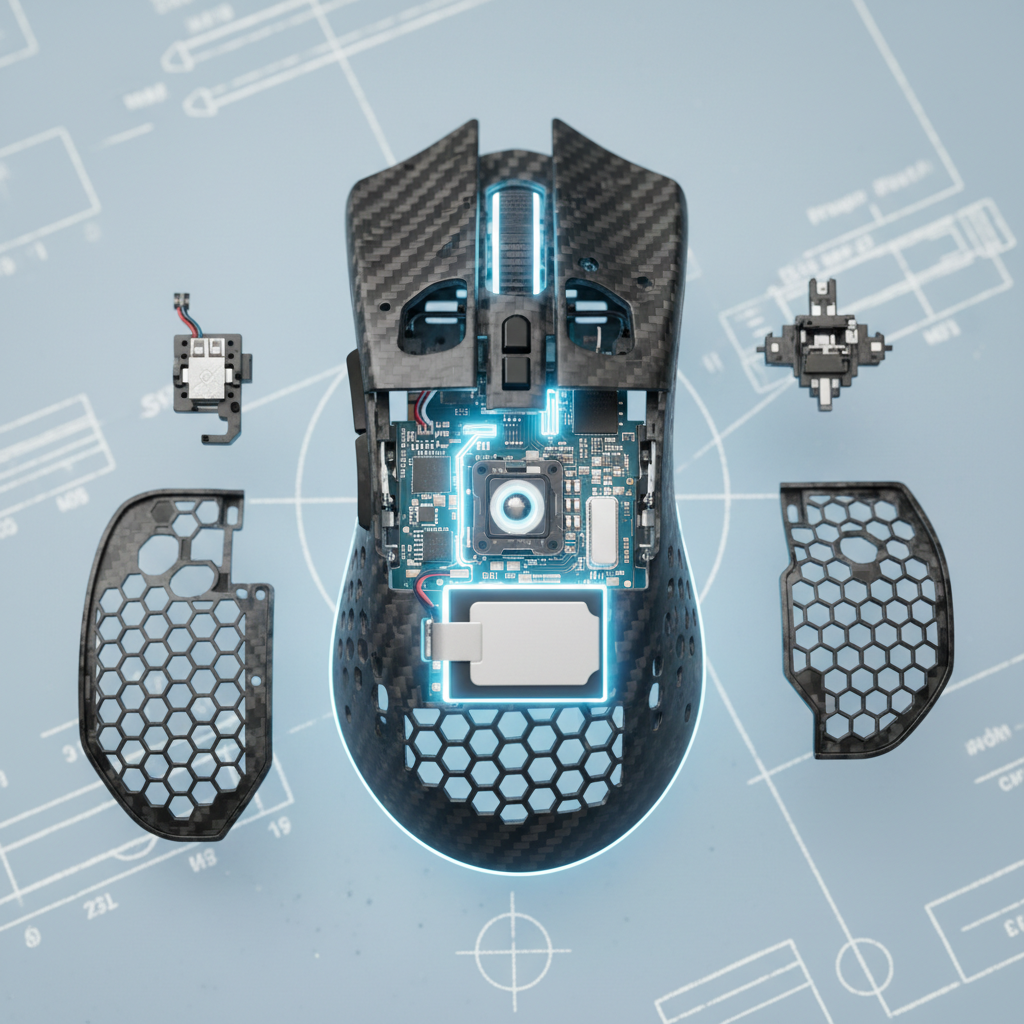
Conversely, ultra-light enthusiasts may prefer the ATTACK SHARK R11 ULTRA Carbon Fiber Mouse. At 49g, it is designed for maximum agility. When paired with a Carbon Fiber Pad, the result is a "speed-biased" setup with minimal physical damping.

Implementing Kinetic Stability: A Practical Checklist
If you are transitioning to a magnesium alloy shell, use this guide to calibrate your setup:
- DPI Scaling: Increase your base DPI to 1600 if using 4K/8K polling. This ensures the high-frequency MCU has enough data to process even during slow movements.
- Port Integrity: Connect the receiver directly to a Rear Motherboard USB 3.0+ port. Avoid hubs; 8K polling can saturate the bandwidth of shared USB controllers.
- Sensitivity Tuning: Because magnesium has higher rotational inertia, you may find you can increase in-game sensitivity by 2–5% without losing "stopping" control.
- Firmware Verification: Always use the Official Driver Download to ensure "Motion Sync" is correctly toggled for your specific sensor (PAW3395/3950).
- Safety Compliance: For travel, remember that integrated Li-ion batteries must be in cabin baggage per IATA PI 967 regulations.
Summary of Material Impact
The shift toward magnesium in gaming peripherals is a calculated engineering trade-off. By utilizing the density of magnesium alloys, designers balance the speed of a lightweight shell with the kinetic stability required for world-class aim. While carbon fiber remains the king of raw agility, magnesium provides the "planted" sensation that helps tame high-velocity flick shots.
Disclaimer: This article is for informational purposes. Performance metrics are based on theoretical modeling and manufacturer whitepapers; actual results vary by user biomechanics and system configuration.
References:
- Attack Shark Manufacturer Whitepaper (2026): Kinetic Stability Standards.
- NADCA - Magnesium Alloy Properties
- USB-IF HID Class Specifications
- IATA Lithium Battery Guidance
- FCC Equipment Authorization Search


Dejar un comentario
Este sitio está protegido por hCaptcha y se aplican la Política de privacidad de hCaptcha y los Términos del servicio.