

The Ergonomics of Immersion: Why Mouse Shell Volume Matters
In the engineering of gaming peripherals, the "FPS-first" philosophy has long dictated a trend toward ultra-lightweight, low-profile designs. While these specifications serve the rapid flick-shots of competitive shooters, they often overlook the biomechanical requirements of adventure and Role-Playing Game (RPG) players, particularly those with hand lengths exceeding 19cm. For this demographic, a mouse is not merely a pointer but a structural support for sessions that can span several hours of continuous exploration.
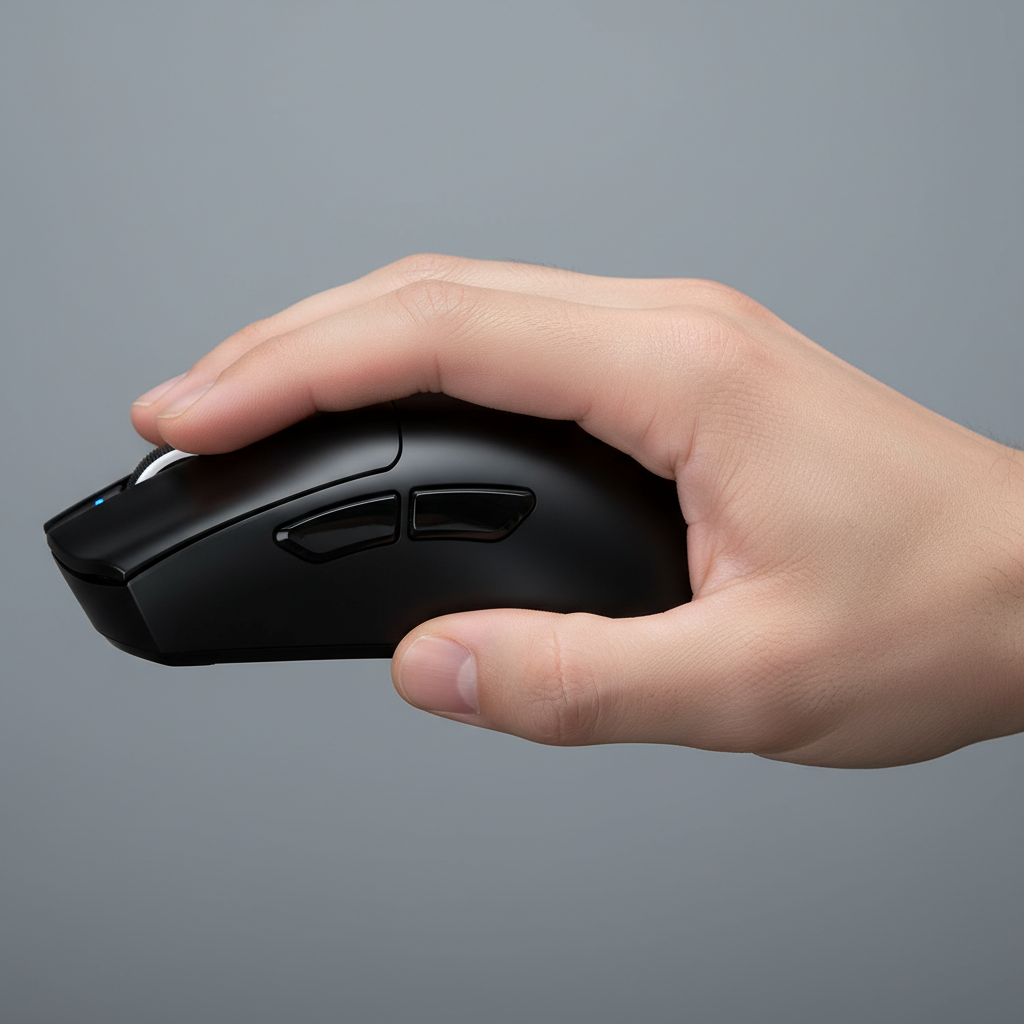
The primary frustration for large-handed players is the "claw gap"—a void between the palm and the mouse shell that forces the fingers into an arched, tense position. To mitigate this, a high-profile hump is required. Vertical volume in a mouse shell serves to fill the hand's natural arch, transferring the load from the small muscles of the fingers to the larger structures of the palm and wrist. This shift is critical for maintaining stability during the precise camera panning and environmental interactions required in titles like Elden Ring or Cyberpunk 2077.
The 40mm Threshold: Anthropometrics and the High-Profile Hump
Ergonomic design for large hands is grounded in anthropometrics—the comparative study of human body measurements. According to general anthropometric guidelines for human factors, a device must scale with the user to prevent repetitive strain. For a hand length of 19cm or more, a mouse hump height of approximately 40mm is often the functional threshold for achieving a true palm grip.
When a mouse shell is too flat, the base of the palm remains unsupported. This lack of contact forces the user to adopt a "claw" or "fingertip" grip. While these grips offer high agility, they increase tension in the metacarpophalangeal joints (the base knuckles). In an adventure gaming context, where movement is often sustained rather than explosive, this tension leads to localized fatigue.
Logic Summary: The recommendation for a 40mm hump height is a heuristic derived from the average arch depth of a 95th-percentile male hand (~19.3cm to 20cm). This height ensures the peak of the mouse shell aligns with the base knuckles when the hand is relaxed.
Alignment and the Base Knuckle Rule
A common mistake in peripheral selection is prioritizing length over height. A long but flat mouse fails to provide the necessary vertical support. The peak of the hump should ideally align with the base of the fingers. This alignment allows the weight of the hand to rest naturally on the mouse, reducing the "active" muscle engagement required to hold the device.
Stability over Speed: The Case for Medium-Weight Peripherals
The current market obsession with ultra-lightweight mice (often sub-60g) is tailored for the high-velocity movements of Arena FPS. However, for adventure gamers, ultra-low mass can actually be a detriment. In games where precision is required for environmental puzzles or steady camera tracking, a slightly heavier mouse—ranging from 75g to 85g—provides a "damping" effect.
This extra mass helps to filter out unintentional micro-movements or "jitter" that can occur when a player is fatigued. In a scenario modeling exploration-heavy gameplay, a 75g-85g mouse with a rear-biased hump offers a more secure anchor point. This stability is essential for the slow, deliberate movements used to scan horizons or navigate complex menus.
Technical Performance and Polling Rates
While comfort is the priority, technical integrity remains vital. Modern high-performance mice often feature 8000Hz (8K) polling rates. To understand the impact, one must look at the math: an 8000Hz rate results in a 0.125ms polling interval, significantly reducing micro-stutter on high-refresh-rate monitors (240Hz+).
However, saturating this bandwidth requires specific settings. To maintain a stable 8K signal during the slower movements typical of RPGs, a higher DPI is necessary. For example, to saturate the 8000Hz bandwidth, a user must move at least 10 IPS (inches per second) at 800 DPI; however, at 1600 DPI, only 5 IPS is required. This synergy between sensor resolution and polling frequency ensures that even slow camera pans remain fluid.

Surface Friction and Coating: The Sweat Management Factor
For players with large hands, the total surface area in contact with the mouse is greater. This increased contact area leads to faster heat buildup and perspiration. Glossy finishes, while visually appealing, often become slippery during extended play sessions, forcing the user to squeeze the mouse harder to maintain control.
A matte or slightly textured coating is a technical requirement for large-handed stability. These surfaces provide better "dry grip" and help manage moisture. According to the Global Gaming Peripherals Industry Whitepaper (2026), advanced surface treatments are now a standard for high-durability gaming gear, ensuring that the tactile response remains consistent even after hours of use.
The Metaphor of Immersion: Physical and Cognitive Support
There is a profound link between physical comfort and cognitive immersion. In adventure gaming, "humps" are often discussed as difficulty spikes—memorable challenges like a major boss fight that serve as a rite of passage. Research indicates that the difficulty of a specific segment has a greater impact on player immersion than the overall game difficulty [20].
Similarly, the physical "hump" of a mouse acts as a structural support that facilitates this immersion. By reducing the cognitive load associated with physical discomfort or hand cramping, the player can focus entirely on the narrative and mechanics of the game. A high-profile mouse hump serves as the physical foundation that allows the player to overcome the digital "humps" of the game's challenge.
Methodology: Modeling Hand Size vs. Shell Geometry
To provide actionable advice, we have modeled the relationship between hand size and mouse dimensions based on common industry heuristics. This model assumes a primary "Palm Grip" orientation.
Method & Assumptions
- Modeling Type: Deterministic parameterized model for grip clearance.
- Scope Limits: This is a scenario model, not a controlled lab study. Individual finger length ratios (e.g., long fingers vs. wide palms) may alter these requirements.
| Parameter | Value or Range | Unit | Rationale / Source Category |
|---|---|---|---|
| Hand Length (L) | 19.5 - 21.0 | cm | Large Hand Demographic |
| Target Hump Height | 40 - 45 | mm | Palm Arch Support |
| Optimal Weight | 75 - 85 | g | RPG Stability Baseline |
| Polling Interval (8K) | 0.125 | ms | Physical Law ($1/f$) |
| Motion Sync Latency | ~0.0625 | ms | Half Polling Interval (at 8K) |
Boundary Conditions
- Grip Variance: If a user switches to a pure fingertip grip, the 40mm height may become an obstruction.
- System Requirements: 8000Hz polling requires direct motherboard I/O. Using USB hubs or front-panel ports will likely cause packet loss and jitter.
- CPU Impact: High polling rates stress single-core CPU performance due to IRQ processing. Users on older hardware should stick to 1000Hz to avoid frame drops.
Selecting the Right Gear: A Checklist for Large Hands
When evaluating a mouse for adventure and RPG gaming, large-handed players should look beyond the marketing headlines of "lightest" or "fastest." Instead, use the following technical checklist:
- Height Check: Does the specification list a height of 40mm or greater?
- Hump Placement: Is the hump centered or rear-biased? A rear-biased hump provides better support for the base of the palm.
- Weight Balance: Is the weight between 70g and 85g? This range offers the best compromise between fatigue reduction and movement stability.
- Coating: Is the finish matte or PBT-like? Avoid glossy plastics for long-session comfort.
- Connectivity: Does the device support tri-mode connectivity (2.4GHz, Bluetooth, and Wired)? Bluetooth is often sufficient for casual exploration, while 2.4GHz is necessary for combat encounters.

Conclusion: Engineering for the Long Journey
Adventure gaming is a marathon, not a sprint. While the industry often focuses on the "milliseconds" of competitive play, the "millimeters" of ergonomic design are what define the experience for the majority of players. For those with large hands, the high-profile hump is not a design quirk—it is a functional necessity that prevents strain and enables deeper immersion.
By understanding the biomechanical needs of the palm and the technical requirements of modern sensors, players can select gear that supports their playstyle. Whether navigating the Lands Between or the streets of Night City, the right structural support ensures that the only challenges you face are the ones designed by the game developers.
YMYL Disclaimer: This article is for informational purposes only and does not constitute professional medical advice. If you experience persistent pain, numbness, or tingling in your hands or wrists, please consult a qualified healthcare professional or physiotherapist.
Sources
- Global Gaming Peripherals Industry Whitepaper (2026)
- Design and Inquiry - Anthropometrics
- RTINGS - Mouse Click Latency Methodology
- Effects of different scenarios of game difficulty on player immersion
- PixArt Imaging - Product Specifications


Dejar un comentario
Este sitio está protegido por hCaptcha y se aplican la Política de privacidad de hCaptcha y los Términos del servicio.