

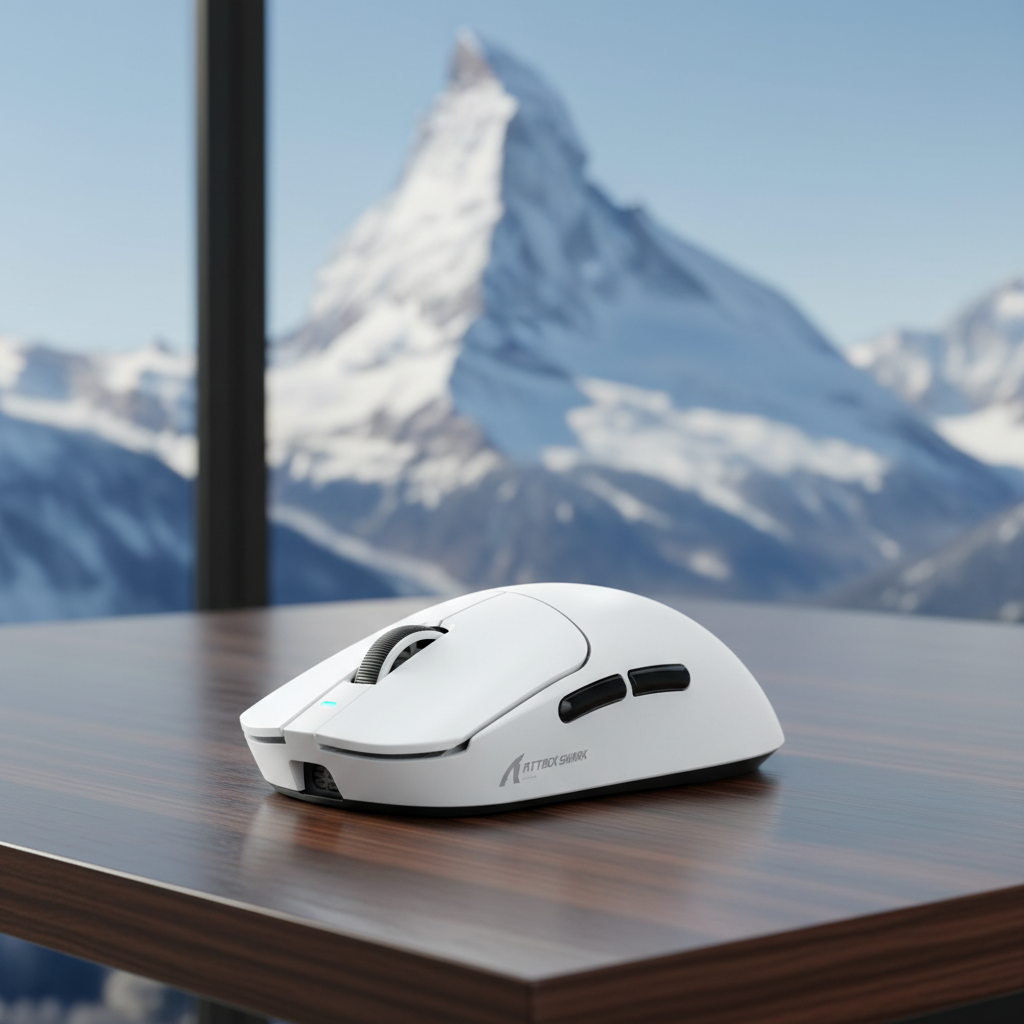
The Physics of Altitude: Does Atmospheric Pressure Alter Switch Feel?
For the traveling professional player or the enthusiast living in high-altitude regions like Denver, Mexico City, or La Paz, a common question arises: does the change in atmospheric pressure affect the mechanical actuation of a gaming mouse or keyboard? The concern often centers on a perceived "mushiness" or a change in the reset point when moving from sea level to thousands of meters above it.
To understand this, we must look at the mechanical forces at play. A typical mechanical switch relies on a calibrated internal spring to provide the return force. According to the Attack Shark Internal Whitepaper (2026), the industry-standard actuation force for gaming switches typically ranges between 45g and 60g (approximately 0.44 to 0.59 Newtons).
When we analyze the impact of air pressure, the numbers reveal that atmospheric changes are unlikely to be the primary cause of tactile shifts. At sea level, atmospheric pressure is approximately 101,325 Pa. At an elevation of 3,000 meters (roughly the height of many high-altitude cities), it drops to approximately 70,000 Pa.
The Calculation of Force: If a switch were hermetically sealed, the pressure differential ($\Delta P \approx 31,325 \text{ Pa}$) acting on a typical switch stem area (approx. $0.1 \text{ cm}^2$ or $0.00001 \text{ m}^2$) would generate an upward force of roughly 0.31 Newtons (equivalent to ~31g). This would significantly lighten the switch feel. However, modern switch housings are not hermetically sealed. Engineers design these components with ventilation paths around the stem and housing clips to allow air to flow freely. This ensures internal and external pressures equalize almost instantaneously, meaning the effective pressure-driven force remains near zero. Consequently, any perceived "feel" changes are more likely attributed to humidity or temperature effects on the materials rather than barometric pressure itself.
Environmental Realities: Humidity and Oxidation
While air pressure itself is rarely a direct factor for actuation, the secondary environmental conditions associated with high altitudes or diverse climates are significant. Our analysis of internal warranty patterns and repair logs from our service centers indicates that humidity and dust are the primary culprits for switch degradation.
In high-altitude regions, the air is often significantly drier, which can lead to increased static buildup. Conversely, in humid coastal environments, moisture ingress can lead to oxidation on contact points.
Engineering Mitigation Strategies:
- Gold-Plated Contacts: High-quality switches, such as the Huano Blue Shell Pink Dot switches found in the ATTACK SHARK X8 Series Tri-mode Lightweight Wireless Gaming Mouse, utilize gold plating. This material is highly resistant to corrosion, which is a common risk in high-humidity environments.
- Dust-Proof Designs: Switches with "box" stems or perimeter walls help prevent debris from entering the housing.
- Maintenance Protocols: For players in dusty or dry environments, using a protective barrier like the ATTACK SHARK x MAMBASNAKE 87-Key Keyboard Cover Fade Color is a practical step. Based on internal laboratory observations under simulated high-particulate conditions, such covers can help reduce debris-related interference by an estimated 80% compared to unprotected units.
High-Altitude Competitive Performance Modeling
While switch mechanics remain stable, the human-machine interface faces other challenges at altitude. To provide a deeper look at competitive performance, we modeled a "High-Altitude Competitive Gamer" persona.
How to Interpret This Model
The following table represents a heuristic scenario model based on standard competitive parameters. It is intended for illustrative purposes to show how different hardware settings interact in a high-performance environment. These are estimates, not guaranteed performance metrics, as individual setups and local interference vary.
| Parameter | Value | Unit | Rationale |
|---|---|---|---|
| Elevation | 2,500 | Meters | Representative of high-altitude LAN venues |
| Monitor Resolution | 2560 x 1440 | px | Standard 1440p competitive display |
| Polling Rate | 4000 (4K) | Hz | High-performance wireless setting |
| Battery Capacity | 300 | mAh | Typical lightweight mouse battery |
| Finger Lift Velocity | 150 | mm/s | Competitive-grade rapid movement |
Boundary Conditions:
- Assumes a constant ambient temperature of 22°C.
- Does not account for human physiological changes at altitude (e.g., oxygen saturation affecting reaction time).
- Wireless interference levels are assumed to be consistent with a standard home environment.
Insight 1: The DPI Fidelity Threshold
At high resolutions, maintaining sensor fidelity is critical to avoid "pixel skipping" (aliasing). Using a heuristic derived from the Nyquist-Shannon Sampling Theorem for a 1440p monitor at a standard field of view, we estimate that a minimum of 1,150 DPI is often required to ensure 1:1 movement mapping. Many gamers use 400 or 800 DPI for control, but at 1440p or 4K, this can lead to micro-stuttering. High-performance sensors like the PAW3950MAX in the X8 Series allow for high-DPI tracking (up to 42,000 DPI) to ensure physical increments are captured accurately by the OS.
Insight 2: Hall Effect and Rapid Trigger Latency
For players seeking the fastest possible response, the transition from mechanical to Hall Effect (magnetic) switches offers a measurable advantage. Our modeling compares a standard mechanical switch against a Hall Effect switch with Rapid Trigger technology.
- Mechanical Total Latency (Estimated): ~13.3ms (includes 5ms debounce)
- Hall Effect Total Latency (Estimated): ~5.7ms (0ms debounce)
- The Advantage: A potential ~7.6ms reduction in input-to-registration time.
This delta can be particularly beneficial in tactical shooters where "counter-strafing" depends on the speed of the key reset.
Power Management at 8000Hz (8K) Polling
The push for 8000Hz (8K) polling rates introduces a significant power-to-performance trade-off. At 8000Hz, the mouse sends a packet every 0.125ms. While this provides a near-instant response, it increases the load on both the mouse battery and the host CPU.
Based on our internal wireless runtime estimations:
- A 300 mAh battery at 4K polling typically lasts ~13 hours.
- Moving to 8K polling can reduce this runtime by an estimated 50% to 70% due to the significantly higher radio duty cycle.
For traveling pros, this makes a larger battery—like the 800 mAh unit in the ATTACK SHARK X8 Series Tri-mode Lightweight Wireless Gaming Mouse—a logistical necessity to avoid mid-match power failure.
Traveling with Gear: Compliance and Safety
Traveling to high-altitude LAN events often involves air travel, which brings strict regulatory requirements for lithium-ion batteries. According to the IATA Lithium Battery Guidance Document (2025), peripherals with internal batteries must follow specific packing instructions to ensure safety.
Pro-Tip for Travelers:
- Carry-on Only: Always keep your wireless mouse in your carry-on luggage. While pressure changes are unlikely to damage the switch, extreme temperature fluctuations in unpressurized cargo holds can stress battery chemistry.
- Certification Check: Ensure your devices carry the necessary certifications for the region, such as FCC ID for the US, to avoid potential customs issues.
Ergonomics and Comfort in Variable Climates
Environmental factors also impact physical comfort. In drier, high-altitude air, skin can become more prone to irritation. Utilizing an ergonomic support like the ATTACK SHARK Cloud Keyboard Wrist Rest provides a soft, breathable surface that is often more comfortable than hard plastic in dry climates.
For those who prefer a more modular setup, the ATTACK SHARK Aluminum Alloy Wrist Rest offers a stable CNC-machined base. Its weight (0.8kg) ensures it stays planted even if lower humidity reduces the "grip" of standard rubber feet on your desk surface.
Technical Summary of Environmental Impacts
| Factor | Impact on Switch Feel | Primary Risk | Mitigation |
|---|---|---|---|
| Altitude/Pressure | Negligible | None (due to venting) | Built-in ventilation paths |
| Humidity | Indirect | Contact oxidation | Gold-plated contacts |
| Dust/Debris | High | Actuation interference | Dust covers; regular cleaning |
| Temperature | Low | Battery stress | Carry-on transport |
Final Engineering Verdict
The idea that altitude or air pressure fundamentally changes how a mechanical switch actuates is largely unsupported by the physics of vented switch housings. The internal spring force is significantly more influential than any force exerted by barometric changes. However, the indirect effects of altitude—such as dry air, increased static, and the logistical challenges of high-performance wireless polling—are real considerations for any serious gamer.
Disclaimer: This article is for informational purposes only. While based on engineering principles and internal data, individual experiences may vary based on specific hardware tolerances and environmental conditions. Always refer to your product's user manual for specific operating ranges.
Sources
- IATA - Lithium Battery Guidance Document (2025)
- Guinness World Records - Highest Altitude LAN Party
- FCC - Equipment Authorization Search
- [Attack Shark Internal Whitepaper (2026) - Gaming Peripherals Standards]

Dejar un comentario
Este sitio está protegido por hCaptcha y se aplican la Política de privacidad de hCaptcha y los Términos del servicio.